Ford Super Duty F-250 F-350 F-450 F-550 2000-2004 Workshop Repair Manual
|
Ford Super Duty
Compatible with: All Windows Systems |
Ford Super Duty
Just £9.95
Instant Download |
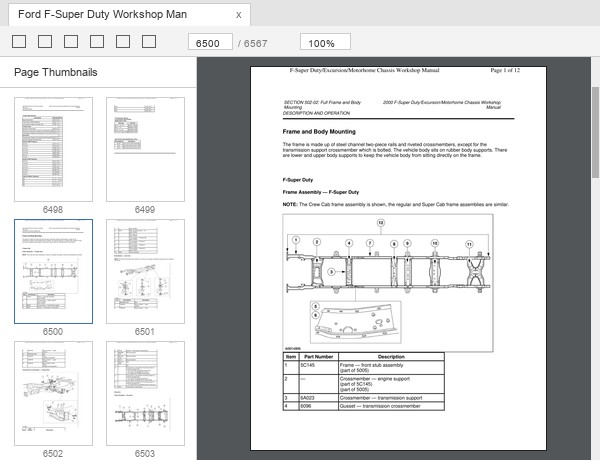
This is Ford's own workshop manual for the F-Super Duty, 6,567 pages in a single searchable PDF. It is a chassis manual rather than a single-model book, so F-250, F-350, F-450 and F-550 are all documented in it, along with the F53 motorhome chassis and the Excursion that shares the same frame. The phrase “F-Super Duty” appears more than 8,100 times through the text. Section 502-02 opens by describing exactly what you are working on: “The frame is made up of channel steel two-piece rails and riveted crossmembers, except for the transmission support crossmember which is bolted.”
Which vehicles this manual fits
- Fits: Ford F-250, F-350, F-450 and F-550 Super Duty, plus the F53 motorhome chassis. All three cab styles are covered, and the manual says so itself in the frame section: “The Crew Cab frame assembly is shown, the regular and Super Cab frame assemblies are similar”
- Covers years: 2004, 2003, 2002, 2001, 2000
- Engine options: 5.4L Triton V8, 6.8L Triton V10 and the 7.3L direct-injection turbo diesel V8, listed in the specifications as “7.3L, OHV, DI Turbo, V8, Diesel, F-Series/Excursion”. Bi-fuel trucks have their own fuel system and fuel tank sections
- Diesel note: the diesel here is the 7.3L. Ford replaced it with the 6.0L during 2003, and the 6.0L is not covered in this book. If your truck is a 2003 or 2004 with the 6.0L, every section outside the engine and its fuel system still applies
- Gearbox: 4R100 automatic with separate cooling and external control sections, the earlier E4OD, and two manuals, the ZF S5-47 five-speed and the ZF six-speed
- Rear axles: Dana 80, Dana S135 and the Ford 10.50-inch ring gear, with full floating wheel hubs documented in both Dana and Ford forms. Dual rear wheel trucks are covered throughout
- Power take-off: PTO-equipped trucks are handled in the transmission sections, with the control logic spelled out, for example that the coast clutch solenoid stays energised during PTO operation
- Language: English
- Pages: 6,567 in a single PDF
- File type: PDF
Inside this manual
Every entry below is a section present in the document, and the numbers are Ford's own:
- 100-01/02 Identification Codes, Jacking and Lifting
- 100-04 Noise, Vibration and Harshness
- 204-00 Suspension System – General Information
- 204-01A/B Front Suspension – 4x2 and 4x4
- 204-02 Rear Suspension
- 204-04 Wheels and Tires
- 205-00 Driveline System – General Information
- 205-01 Driveshaft
- 205-02A/B Rear Drive Axle/Differential – Dana 80 and Dana S135
- 205-02C/E Wheel Hubs and Bearings – Full Floating Axle, Dana and Ford
- 205-02D Rear Drive Axle/Differential – Ford 10.50-Inch Ring Gear
- 205-03 Front Drive Axle/Differential
- 206-00 Brake System – General Information
- 206-03/04 Front and Rear Disc Brake
- 206-05 Parking Brake and Actuation
- 206-06/07 Hydraulic and Power Brake Actuation
- 206-09A/B Anti-Lock Control – Rear and Four-Wheel
- 211-00/03 Steering System and Steering Linkage
- 211-02 Power Steering
- 211-04/05 Steering Column and Column Switches
- 303-00 Engine System – General Information
- 303-01A Engine – 5.4L (2V)
- 303-01B Engine – 6.8L
- 303-01C Engine – 7.3L Diesel
- 303-03 Engine Cooling
- 303-04A/B Fuel Charging and Controls – 5.4L (2V) and 6.8L
- 303-04C Fuel Charging and Controls – 7.3L Diesel
- 303-04D Fuel Charging and Controls – Turbocharger
- 303-04E Fuel Charging and Controls – Bi-Fuel Vehicles
- 303-05 Accessory Drive
- 303-06A/B Starting System – Gasoline and Diesel Engines
- 303-07A Engine Ignition – 5.4L and 6.8L
- 303-07B Glow Plug System
- 303-08 Engine Emission Control
- 303-12 Intake Air Distribution and Filtering
- 303-13 Evaporative Emissions
- 303-14A/B Electronic Engine Controls – Gasoline and Diesel
- 307-01 Automatic Transaxle/Transmission
- 307-02/05 Transmission Cooling and External Controls
- 308-00 Manual Transmission and Clutch – General Information
- 308-01/02 Clutch and Clutch Controls
- 308-03A/B Manual Transmission – ZF S5-47 and ZF 6-Speed
- 308-07A Four-Wheel Drive Systems
- 308-07B Transfer Case
- 309-00 Exhaust System – General Information
- 310-00A/B Fuel System – General Information, Gasoline, Diesel and Bi-Fuel
- 310-01A/B Fuel Tank and Lines – Gasoline, Diesel and Bi-Fuel
- 310-02 Acceleration Control
- 310-03 Speed Control
- 412-00 Climate Control System – General Information
- 412-01/02 Air Distribution, Filtering, Heating and Ventilation
- 412-03A/B Air Conditioning and Auxiliary Climate Control
- 412-04 Control Components
- 413-00/01 Instrument Cluster and Panel Illumination
- 413-06 Horn
- 413-08/09 Information and Message Center, Warning Devices
- 413-13 Parking Aid
- 414-00 Charging System – General Information
- 414-01/02 Battery, Cables, Generator and Regulator
- 415-00 Audio System – General Information
- 415-01/02/03 Audio Unit, Antenna and Speakers
- 417-01 Exterior Lighting
- 417-02 Interior Lighting
- 417-04 Daytime Running Lamps
- 418-00/01 Module Communications Network and Configuration
- 419-01 Anti-Theft – PATS
- 419-10 Multifunction Electronic Control Modules
- 501-00 Body System – General Information
- 501-02 Front End Body Panels
- 501-03 Body Closures
- 501-04 Pickup Bed and Platform Body
- 501-05/08 Interior and Exterior Trim and Ornamentation
- 501-09 Rear View Mirrors
- 501-10 Seating
- 501-11 Glass, Frames and Mechanisms
- 501-12 Instrument Panel and Console
- 501-14 Handles, Locks, Latches and Entry Systems
- 501-16 Wipers and Washers
- 501-20A/B Safety Belt System and Supplemental Air Bag System
- 502-02 Full Frame and Body Mounting
Sample pages from this manual
These are real pages taken from the document:
What you can repair with it
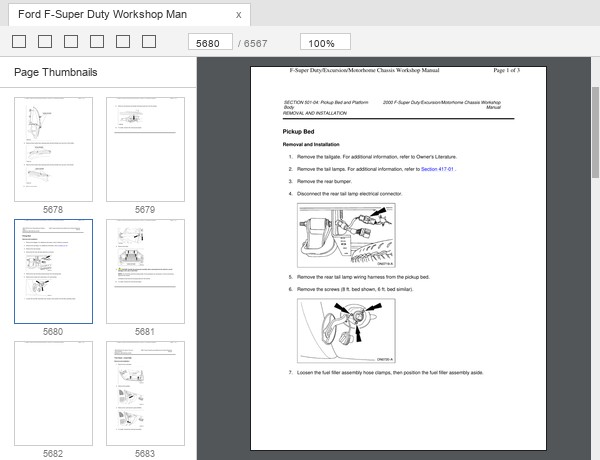
The work that separates a Super Duty from a light truck is here in full. Section 501-04 covers the pickup bed and platform body, taking you through bed removal step by step with the note that the eight foot bed is shown and the six foot bed is similar. Section 502-02 covers the full frame and body mounting, with the frame assembly illustrated and every crossmember, gusset and stub assembly numbered and listed by Ford part number. If you are dealing with a chassis cab, a flatbed conversion or corrosion in the rails, that is the section you will live in.
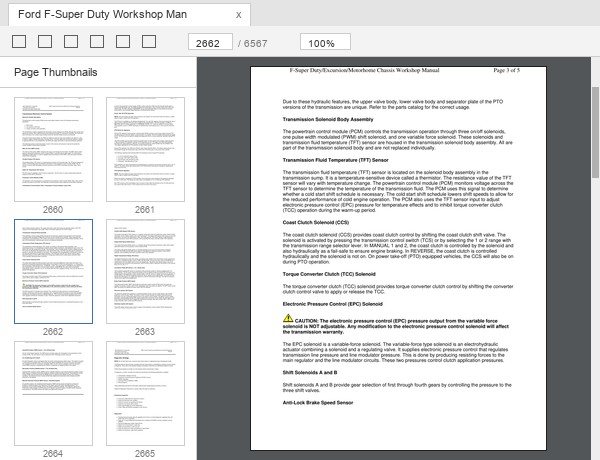
Power take-off gets proper treatment instead of a passing mention. The transmission sections explain how a PTO-equipped truck behaves differently, including which solenoids stay energised while the PTO is running and how the powertrain control module treats the request. Anyone maintaining a truck with a tipper, a crane or a utility body will recognise why that matters.
Underneath, coverage follows the hardware, not the badge on the tailgate. The Dana 80, the Dana S135 and the Ford 10.50-inch ring gear each have their own axle section, and full floating wheel hubs are documented in both Dana and Ford forms, which is what you need for dual rear wheel trucks. Braking is split so that rear-wheel anti-lock and four-wheel anti-lock are documented apart from one another, and the front suspension is split again between two-wheel drive and four-wheel drive. Four-wheel drive systems and the transfer case each get a section of their own.
Engine work is organised the same way. The 5.4L Triton V8, the 6.8L Triton V10 and the 7.3L turbo diesel each have a full engine section, and the diesel adds its own fuel charging and controls section, a turbocharger section and a glow plug system section. Electronic engine controls are separated into gasoline and diesel, as is the starting system, so you are never reading around an engine you do not have.
Manual language and format
The manual is in English, supplied as a single PDF running to 6,567 pages. Because the text layer is intact you can search a Ford section number, a part number or a torque figure and land on the right page, and individual pages print cleanly for taking out to the truck. Any standard PDF reader opens it, on Windows, Mac, tablet or phone.
Questions about this manual
What year did Ford stop putting the 7.3 in their trucks?
The 7.3L Power Stroke diesel finished during the 2003 model year, when the 6.0L took over. That is the engine documented in this manual, so the diesel coverage here suits trucks up to that changeover. Worth clearing up a common mix-up: the 7.3L that Ford reintroduced later is a petrol V8 nicknamed the Godzilla and has nothing to do with this diesel beyond sharing a capacity.
How much can an F-350 dually tow?
A workshop manual does not carry towing ratings, and you should not take one from a website either. Your figure depends on cab, bed, axle ratio and engine, and it is printed on the door jamb sticker and in the towing guide for your build. What this manual does give you is the hardware behind the number, including the rear axles up to the Dana S135, the springs, the hitch mounting points on the frame and the frame itself.
What is the real difference between an F-250 and an F-350?
For repair purposes it comes down to what is under the back of the truck. This manual documents F-250, F-350, F-450 and F-550 side by side, and the differences that change a job are the rear axle fitted, single or dual rear wheels, and the springs. That is why the axles have separate sections by type instead of by model, and why full floating hubs are covered in both Dana and Ford versions.
Does this cover the Crew Cab and the SuperCab, or only the regular cab?
All three. The manual makes the point itself in the frame section, noting that the Crew Cab frame assembly is the one illustrated and that the regular and Super Cab frames are similar, and the body sections carry the same convention for door trim and rear door mechanisms on SuperCab and Crew Cab bodies.
Will this work on my 2004 F-250?
Yes for everything except one case. Ford dated this book to 2000 and the mechanical package carried through to 2004, so suspension, axles, brakes, frame, body, climate control and electrical all apply. The exception is the diesel engine: if your 2004 came with the 6.0L instead of the 7.3L, the engine and its fuel system sections will not match your truck, though the rest of the manual still will.
How you receive it
Checkout is secure and your download link follows straight away, with nothing posted and nothing to wait in for. Keep the file, and re-download it as needed while the link stays active.
Ford Excursion 2000-2004 Workshop Repair Manual
|
Ford Excursion
Compatible with: All Windows Systems |
Ford Excursion
Just £9.95
Instant Download |
This is Ford's own workshop manual for the Excursion, 6,567 pages in a single searchable PDF. Ford published it as one book for three vehicle lines that share a chassis, so every page header reads “2000 F-Super Duty/Excursion/Motorhome Chassis Workshop Manual” and the Excursion is named more than 8,500 times through the text. Ford's numbered section scheme is intact, so 303-01C is the 7.3L diesel, 307-01 is the automatic transmission and 502-02 is the full frame. The engine coverage is the launch powertrain: 5.4L Triton V8, 6.8L Triton V10 and the 7.3L direct-injection turbo diesel V8, described in the specifications as “7.3L, OHV, DI Turbo, V8, Diesel, F-Series/Excursion”.
Which vehicles this manual fits
- Fits: Ford Excursion, first and only generation. Two-wheel drive and four-wheel drive each have their own front suspension section, and the book carries Excursion body work including the liftgate, the third row seating and the running boards
- Covers years: 2004, 2003, 2002, 2001, 2000
- Engine options: 5.4L Triton 2-valve V8 (firing order 1-3-7-2-6-5-4-8), 6.8L Triton V10 (firing order 1-6-5-10-2-7-3-8-4-9) and the 7.3L DI Turbo diesel V8, the engine most owners know as the Power Stroke. Bi-fuel vehicles get their own fuel system and fuel tank sections
- Diesel note: the diesel documented here is the 7.3L, which Ford fitted to the Excursion from launch until 2002. Trucks built from 2003 carry the 6.0L diesel instead, and that engine is not covered in this book. Everything outside the engine bay applies across the whole run
- Gearbox: 4R100 four-speed automatic with its own cooling and external control sections, plus two manuals, the ZF S5-47 five-speed and the ZF six-speed, with clutch and clutch controls
- Axles and drive: Dana 80, Dana S135 and the Ford 10.50-inch ring gear rear axles, front drive axle, full floating wheel hubs in both Dana and Ford forms, and a four-wheel drive systems section with the transfer case
- Language: English
- Pages: 6,567 in a single PDF
- File type: PDF
Inside this manual
Every entry below is a section present in the document, and the numbers are Ford's own:
- 100-01/02 Identification Codes, Jacking and Lifting
- 100-04 Noise, Vibration and Harshness
- 204-00 Suspension System – General Information
- 204-01A/B Front Suspension – 4x2 and 4x4
- 204-02 Rear Suspension
- 204-04 Wheels and Tires
- 205-00 Driveline System – General Information
- 205-01 Driveshaft
- 205-02A/B Rear Drive Axle/Differential – Dana 80 and Dana S135
- 205-02C/E Wheel Hubs and Bearings – Full Floating Axle, Dana and Ford
- 205-02D Rear Drive Axle/Differential – Ford 10.50-Inch Ring Gear
- 205-03 Front Drive Axle/Differential
- 206-00 Brake System – General Information
- 206-03/04 Front and Rear Disc Brake
- 206-05 Parking Brake and Actuation
- 206-06/07 Hydraulic and Power Brake Actuation
- 206-09A/B Anti-Lock Control – Rear and Four-Wheel
- 211-00/03 Steering System and Steering Linkage
- 211-02 Power Steering
- 211-04/05 Steering Column and Column Switches
- 303-00 Engine System – General Information
- 303-01A Engine – 5.4L (2V)
- 303-01B Engine – 6.8L
- 303-01C Engine – 7.3L Diesel
- 303-03 Engine Cooling
- 303-04A/B Fuel Charging and Controls – 5.4L (2V) and 6.8L
- 303-04C Fuel Charging and Controls – 7.3L Diesel
- 303-04D Fuel Charging and Controls – Turbocharger
- 303-04E Fuel Charging and Controls – Bi-Fuel Vehicles
- 303-05 Accessory Drive
- 303-06A/B Starting System – Gasoline and Diesel Engines
- 303-07A Engine Ignition – 5.4L and 6.8L
- 303-07B Glow Plug System
- 303-08 Engine Emission Control
- 303-12 Intake Air Distribution and Filtering
- 303-13 Evaporative Emissions
- 303-14A/B Electronic Engine Controls – Gasoline and Diesel
- 307-01 Automatic Transaxle/Transmission
- 307-02/05 Transmission Cooling and External Controls
- 308-00 Manual Transmission and Clutch – General Information
- 308-01/02 Clutch and Clutch Controls
- 308-03A/B Manual Transmission – ZF S5-47 and ZF 6-Speed
- 308-07A Four-Wheel Drive Systems
- 308-07B Transfer Case
- 309-00 Exhaust System – General Information
- 310-00A/B Fuel System – General Information, Gasoline, Diesel and Bi-Fuel
- 310-01A/B Fuel Tank and Lines – Gasoline, Diesel and Bi-Fuel
- 310-02 Acceleration Control
- 310-03 Speed Control
- 412-00 Climate Control System – General Information
- 412-01/02 Air Distribution, Filtering, Heating and Ventilation
- 412-03A/B Air Conditioning and Auxiliary Climate Control
- 412-04 Control Components
- 413-00/01 Instrument Cluster and Panel Illumination
- 413-06 Horn
- 413-08/09 Information and Message Center, Warning Devices
- 413-13 Parking Aid
- 414-00 Charging System – General Information
- 414-01/02 Battery, Cables, Generator and Regulator
- 415-00 Audio System – General Information
- 415-01/02/03 Audio Unit, Antenna and Speakers
- 417-01 Exterior Lighting
- 417-02 Interior Lighting
- 417-04 Daytime Running Lamps
- 418-00/01 Module Communications Network and Configuration
- 419-01 Anti-Theft – PATS
- 419-10 Multifunction Electronic Control Modules
- 501-00 Body System – General Information
- 501-02 Front End Body Panels
- 501-03 Body Closures
- 501-04 Pickup Bed and Platform Body
- 501-05/08 Interior and Exterior Trim and Ornamentation
- 501-09 Rear View Mirrors
- 501-10 Seating
- 501-11 Glass, Frames and Mechanisms
- 501-12 Instrument Panel and Console
- 501-14 Handles, Locks, Latches and Entry Systems
- 501-16 Wipers and Washers
- 501-20A/B Safety Belt System and Supplemental Air Bag System
- 502-02 Full Frame and Body Mounting
Sample pages from this manual
These are real pages taken from the document:
What you can repair with it
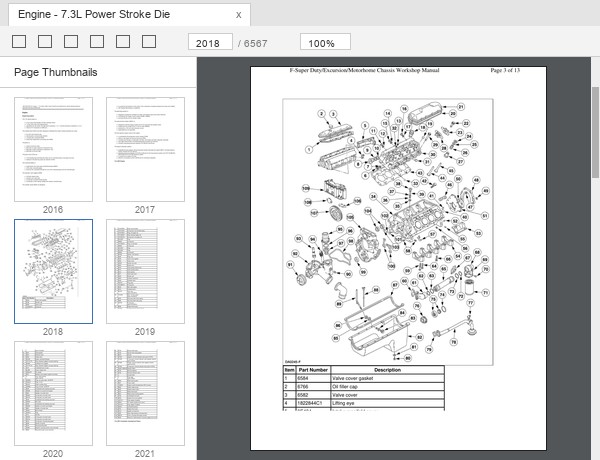
The three engines each get their own section, so you work from the one for the engine actually in front of you. Each carries its own specifications, in-vehicle repair, removal and installation, disassembly and assembly, with exploded views that number every component and list it by Ford part number underneath. The 7.3L diesel adds its own fuel charging and controls section, a turbocharger section and a glow plug system section, which is where most diesel work on these trucks starts.
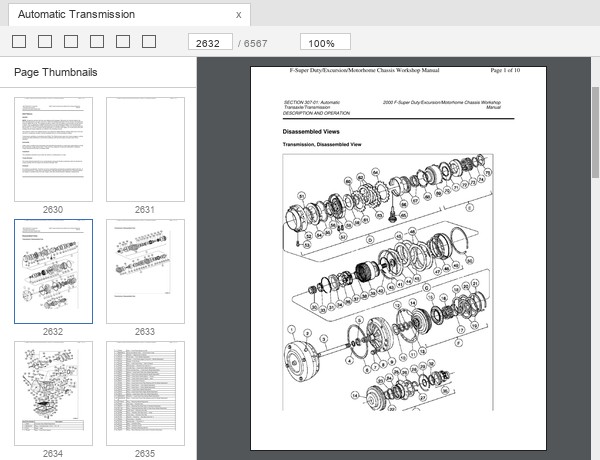
Driveline coverage follows the axle, not the model. Dana 80, Dana S135 and the Ford 10.50-inch ring gear each get their own section, and full floating wheel hubs are covered in both Dana and Ford forms. The 4R100 automatic has separate sections for its cooling circuit and its external controls, and there are two manual gearboxes here, the ZF S5-47 five-speed and the ZF six-speed. Braking is split by system, with rear-wheel anti-lock and four-wheel anti-lock documented apart from each other, which matters because the two use different components.
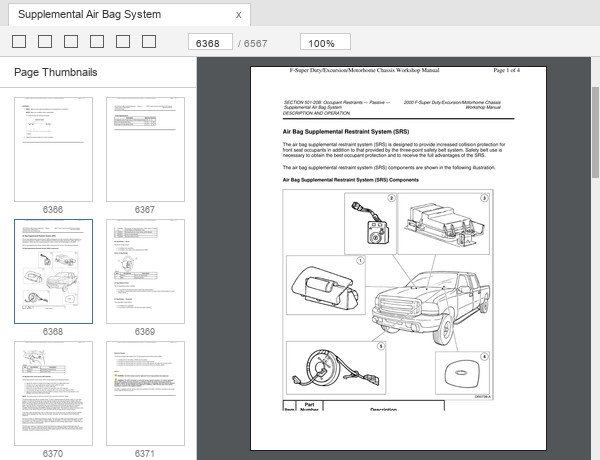
Because this book was written for a chassis rather than one body, it goes further into structure than most SUV manuals. There is a full frame and body mounting section, front end body panels, body closures, and glass, frames and mechanisms. The Excursion-specific work is here too, from the liftgate and its latches through the third row seating to the running boards. Climate control runs to five sections including auxiliary climate control for the rear of the cabin, and the supplemental air bag system has its own section with the components illustrated and listed.
Manual language and format
This manual is written in English and downloads as one PDF of 6,567 pages. It carries a full text layer, so you can search for a section number, a part number or a torque figure and jump straight to it, and pages print individually. It opens on Windows and Mac computers, tablets and phones with any standard PDF reader.
Questions about this manual
Is the Ford Excursion a good SUV?
That is a buying question and this is a repair manual, so it does not answer it. What it does tell you is how much vehicle you are looking after. The Excursion shares its chassis with the F-Super Duty, which is why Ford issued one workshop manual for both, and why the book runs to a full frame and body mounting section, three engine choices up to a 6.8L V10, and rear axles as heavy as the Dana S135.
What engine does a Ford Excursion have?
One of three in the years this manual covers. The 5.4L Triton V8 fires 1-3-7-2-6-5-4-8, the 6.8L Triton V10 fires 1-6-5-10-2-7-3-8-4-9, and the diesel is the 7.3L direct-injection turbo V8 that Ford lists as “7.3L, OHV, DI Turbo, V8, Diesel, F-Series/Excursion”. Each has its own engine section, its own fuel charging and controls section and its own starting system coverage.
How many miles will a 7.3 Power Stroke last?
The manual makes no claim about engine life, and anyone who gives you a figure is guessing. What decides it is whether the service work gets done properly, and that is what this book is for: the 7.3L section covers specifications, in-vehicle repair, removal and installation, disassembly and assembly, with the turbocharger and glow plug system documented separately.
Why is the Ford Excursion so big?
Because underneath it is a Super Duty. Ford built it on the F-Super Duty chassis and documented all three vehicles in this one manual, which is why the header on every page reads “F-Super Duty/Excursion/Motorhome Chassis”. The frame, axles, brakes and powertrain sections you are reading are the truck's.
Which model years does this manual cover?
2000 to 2004. Ford dated the book to the launch year, so the header reads 2000, and the Excursion ran as a single generation from 2000 to 2005. The 5.4L V8 and 6.8L V10 in here were fitted right across that run. The one gap is the diesel: this book documents the 7.3L, which was fitted until 2002, and trucks built from 2003 have the 6.0L instead, which is not covered here. If yours is a 2003 or 2004 diesel, everything except the engine section still applies to your truck.
How you receive it
Payment is processed securely and the download link is issued immediately afterwards, so there is nothing to wait for and nothing shipped. The file is yours to keep and re-download within the link period.
Ford Bronco 2021-2024 Workshop Repair Manual
|
Ford Bronco
Compatible with: All Windows Systems |
Ford Bronco
Just £9.95
Instant Download |
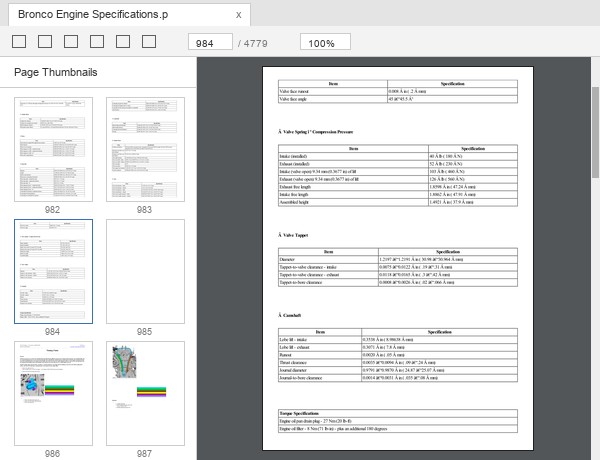
This is Ford factory service documentation for the sixth-generation Bronco, supplied as a single PDF of 4,779 pages. It follows Ford's own numbered section scheme, so 501-18A is the soft top, 501-18B is the hard top and 308-07C is the part-time four-wheel drive transfer case. Every procedure carries its own revision date, and the removable roof is documented as a serviceable system rather than an accessory.
Which vehicles this manual fits
- Fits: Ford Bronco, sixth generation, two-door and four-door. This is the full-size Bronco — there is no Bronco Sport content in the document
- Covers years: 2024, 2023, 2022, 2021
- Engine options: 2.3L EcoBoost (199kW/270PS) and 2.7L EcoBoost (238kW/324PS), each with its own fuel, cooling and control coverage
- Gearbox: 10R60 ten-speed automatic and the MT88 seven-speed manual, plus the part-time four-wheel drive transfer case
- Language: English
- Pages: 4,779 in a single PDF
- File type: PDF
Inside this manual
Every entry below is a numbered Ford section present in the document:
- 100-00 General Information
- 100-02 Jacking and Lifting
- 204-00 Suspension System – General Information
- 204-01 Front Suspension
- 204-02 Rear Suspension
- 204-04A Wheels and Tires
- 204-04B Tire Pressure Monitoring System
- 205-01 Driveshaft
- 205-02 Rear Drive Axle/Differential
- 205-03A Front Drive Axle/Differential
- 205-04 Front Drive Halfshafts
- 206-00 Brake System – General Information
- 206-03 Front Disc Brake
- 206-04 Rear Disc Brake
- 206-05 Parking Brake and Actuation
- 206-06 Hydraulic Brake Actuation
- 206-07 Power Brake Actuation
- 206-09 Anti-Lock Brake System
- 211-02 Power Steering
- 211-05 Steering Wheel and Column Electrical Components
- 303-00 Engine System – General Information
- 307-01 Automatic Transmission – 10R60 Ten-Speed
- 308-07C Transfer Case – 4x4 with Part Time Engagement
- 310-00B Fuel System – General Information – 2.7L EcoBoost
- 412-00 Climate Control System – General Information
- 413-01 Instrumentation
- 414-00 Charging System – General Information
- 414-01 Battery, Mounting and Cables
- 414-02 Generator and Regulator
- 415-00 Information and Entertainment System
- 417-01 Exterior Lighting
- 417-02 Interior Lighting
- 418-01A Module Configuration
- 419-03A Cruise Control
- 419-04 Side and Rear Vision
- 419-07 Lane Keeping System
- 419-10 Multifunction Electronic Modules
- 501-02 Front End Body Panels
- 501-03 Body Closures
- 501-05 Interior Trim and Ornamentation
- 501-08 Exterior Trim and Ornamentation
- 501-09 Rear View Mirrors
- 501-10A Front Seats
- 501-10B Rear Seats
- 501-11 Glass, Frames and Mechanisms
- 501-12 Instrument Panel and Console
- 501-14 Handles, Locks, Latches and Entry Systems
- 501-16 Wipers and Washers
- 501-18A Soft Top
- 501-18B Hard Top
- 501-19 Bumpers
- 501-20A Seatbelt Systems
- 501-20B Supplemental Restraint System
- 501-25 Body Repairs – General Information
- 501-27 Front End Sheet Metal Repairs
- 501-29 Side Panel Sheet Metal Repairs
- 501-30 Rear End Sheet Metal Repairs
- 501-36 Paint – General Information
- 502-02 Full Frame and Body Mounting
Sample pages from this manual
These are real pages taken from the document:
What you can repair with it
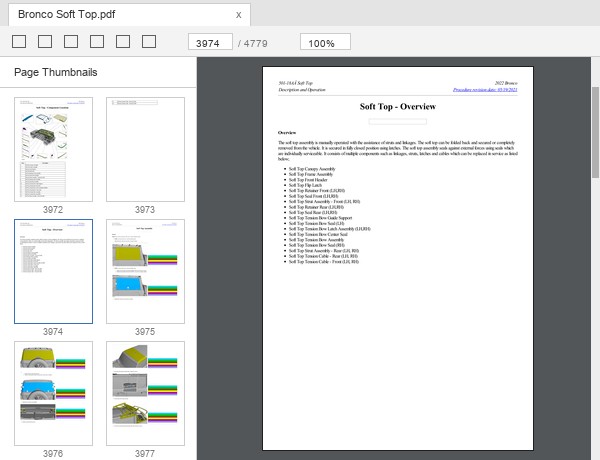
The removable roof gets proper workshop treatment rather than a handbook summary. The soft top section names every component individually — canopy assembly, front header, flip latch, retainers, front and rear seals, tension bow assemblies and centre seal, and the cables that run through the frame tubes — and then gives the removal and installation order for each. The hard top has its own section covering the rear cap assembly, the flip latch bolt cover and the support bar that has to go on first for the top to attach correctly.
Powertrain coverage splits by engine, with the 2.3L EcoBoost and the 2.7L EcoBoost each carrying their own fuel and control material, and by gearbox, with the 10R60 automatic and the MT88 manual documented separately. Four-wheel drive is treated as a part-time system with its own transfer case section, alongside front and rear axles, halfshafts and the driveshaft.
Body and trim work runs from front end panels and closures through interior and exterior trim, glass and mechanisms, seats and the instrument panel, and extends into front end, side panel and rear end sheet metal repair with full frame and body mounting. Electrical diagnosis is supported by wiring diagrams that carry circuit identifiers and wire colours through to each destination module, plus module configuration and the multifunction electronic modules section.
Manual language and format
This manual is written in English and downloads as a single PDF. It carries a text layer, so you can search for a section number, a torque figure or a circuit identifier and jump straight to it. It opens on Windows and Mac computers, tablets and phones, and pages print individually.
Questions about this manual
How does the Bronco soft top come off?
In the order the manual sets out, starting at the latches: press down the handle on the driver side to unlatch the top, then work through the soft top material, the tension bow assemblies and their centre seal, and finally the frame assembly. The cables are pulled out through the frame tubes rather than unbolted. Each of those is a separate numbered procedure, so you can stop at the level you need instead of stripping the whole roof.
How do you put a Bronco soft top back on?
The manual gives installation as its own sequence rather than simply reversing removal, because the order matters — the cable is fitted to the frame assembly first, the seals are seated onto the tension bow, and the assembly is latched last. Where a step is genuinely a straight reversal the manual says so explicitly.
Can a Bronco hard top be removed?
Yes, and it has its own section separate from the soft top. It covers the rear cap assembly, releasing the clips to take off the flip latch bolt cover, and the support bar — which the manual warns must be installed first if you have removed it, otherwise the top will not attach properly.
Which engines and gearboxes are covered?
Both EcoBoost engines — the 2.3L at 199kW/270PS and the 2.7L at 238kW/324PS — and both gearboxes, the 10R60 ten-speed automatic and the MT88 manual. The part-time four-wheel drive transfer case is documented in its own section, so two-wheel and four-wheel drive cars are both served.
Which model years does this manual cover?
It is Ford's workshop information for the sixth-generation Bronco, which began in 2021. The document itself is the 2022 model year edition — its page headers read “2022 Bronco” — and individual procedures carry revision dates running up to 2022, with the bulk revised during 2021.
Are wiring diagrams included?
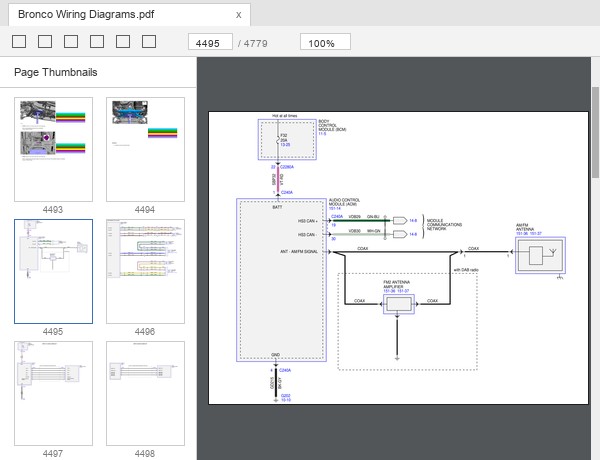
Yes. The diagrams show each fuse by number from the battery junction box, the circuit identifier and wire colour on every branch, and the destination module for each feed, including the audio control module, the module communications network and the antenna circuits. The first sample page above is one of them.
How you receive it
Payment is processed securely and the download link is issued immediately afterwards, so there is nothing to wait for and nothing shipped. The file is yours to keep and re-download within the link period.
Ford Super Duty F-250 F-350 F-450 F-550 2008-2010 Workshop Repair Manual
|
Ford Super Duty
Compatible with: All Windows Systems |
Ford Super Duty
Just £9.95
Instant Download |
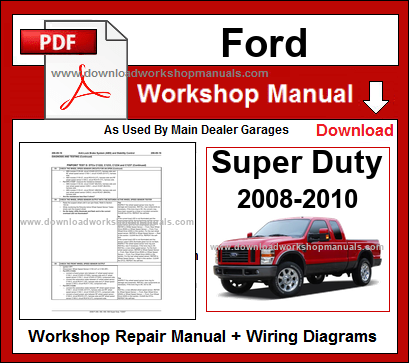
This is Ford's own workshop information for the second-generation Super Duty, the P356 trucks built from 2008 to 2010. It comes as 103 separate section PDFs totalling 7,362 pages. Ford dated the book to the launch year, so every page footer reads “2008 F-250, 350, 450, 550 Super Duty, 7/2007”, and the three engines it documents are the three this generation was sold with. Ford's numbered section scheme is intact throughout, so 303-01C is the 6.4L diesel, 307-01 is the TorqShift automatic and 502-02 is the full frame. One extra section carries over from the previous book: a complete 6.0L Power Stroke diesel engine section whose own footers read “2006 F-250, 350”.
Which vehicles this manual fits
- Fits: Ford F-250, F-350, F-450 and F-550 Super Duty, second generation. Regular Cab, SuperCab and Crew Cab all appear by name in the body sections, alongside pickup and chassis-cab/platform bodies, single and dual rear wheel, and both rear-wheel drive and four-wheel drive
- Covers years: 2010, 2009, 2008
- Also included: a complete 6.0L Power Stroke diesel engine section carried over from the previous book, 239 pages with its own diagnosis, in-vehicle repair, disassembly, assembly and specifications
- Engine options: 6.4L Power Stroke turbo diesel V8 (390 cu in, 17.2:1 compression), 5.4L Triton 3-valve V8 (330 CID, 9.8:1) and 6.8L Triton 3-valve V10 (415 cu in), plus the 6.0L Power Stroke V8 (365 cu in) section above
- Gearbox: TorqShift® automatic (466 pages) and the ZF 6-speed manual with clutch and clutch controls, plus the transfer case in both manual-shift and electronic-shift form and the four-wheel drive systems section
- Language: English
- Pages: 7,362 across 103 section PDFs in one download
- File type: PDF (supplied as a ZIP containing the 103 sections, foldered by system)
Inside this manual
Every entry below is a section present in the document, and the numbers are Ford's own:
- 100-01/02 Identification Codes, Jacking and Lifting
- 100-03 Maintenance Schedule
- 100-04 Noise, Vibration and Harshness
- 204-00 Suspension System – General Information
- 204-01A/B Front Suspension – Rear Wheel Drive and Four Wheel Drive
- 204-02 Rear Suspension
- 204-04 Wheels and Tires
- 205-00 Driveline System – General Information
- 205-01 Driveshaft
- 205-02A/B Rear Drive Axle/Differential – Dana 80, S110 and S130
- 205-02C/E Wheel Hubs and Bearings – Full Floating Axle
- 205-02D Rear Drive Axle/Differential – Ford 10.50-Inch Ring Gear
- 205-03 Front Drive Axle/Differential
- 206-00 Brake System – General Information
- 206-03/04 Front and Rear Disc Brake
- 206-05 Parking Brake and Actuation
- 206-06/07 Hydraulic and Power Brake Actuation
- 206-09 Anti-Lock Brake System (ABS) and Stability Control
- 206-10 Auxiliary Brake System
- 211-00/03 Steering System and Steering Linkage
- 211-02 Power Steering
- 211-04 Steering Column
- 211-05 Steering Column Switches
- 303-00 Engine System – General Information
- 303-01A Engine – 5.4L (3V)
- 303-01B Engine – 6.8L (3V)
- 303-01C Engine – 6.4L Diesel
- 303-03 Engine Cooling
- 303-04A/B Fuel Charging and Controls – 5.4L and 6.8L (3V)
- 303-04C Fuel Charging and Controls – 6.4L Diesel
- 303-04D Fuel Charging and Controls – Turbocharger
- 303-04E Fuel Charging and Controls – Fuel and Turbocharger Cooling
- 303-05 Accessory Drive
- 303-06A/B Starting System – Gasoline and Diesel Engines
- 303-07A Engine Ignition – 5.4L and 6.8L (3V)
- 303-07B Glow Plug System
- 303-08 Engine Emission Control
- 303-12 Intake Air Distribution and Filtering
- 303-13 Evaporative Emissions
- 303-14A/B Electronic Engine Controls – Gasoline and Diesel
- 307-01 Automatic Transaxle/Transmission – TorqShift®
- 307-02/05 Transmission Cooling and External Controls
- 308-00 Manual Transmission and Clutch – General Information
- 308-01/02 Clutch and Clutch Controls
- 308-03 Manual Transaxle/Transmission – ZF 6-Speed
- 308-07A Four Wheel Drive (4WD) Systems
- 308-07B Transfer Case
- 309-00 Exhaust System
- 310-00 Fuel System – General Information – Gasoline and Diesel
- 310-01 Fuel Tank and Lines – Gasoline and Diesel
- 310-02 Acceleration Control
- 310-03 Speed Control
- 412-00 Climate Control System – General Information and Diagnostics
- 412-01 Climate Control
- 413-00/01 Instrument Cluster, Message Center and Warning Chimes
- 413-06 Horn
- 413-13 Parking Aid
- 414-00 Charging System – General Information and Diagnostics
- 414-01/02 Battery, Cables, Generator and Regulator
- 415-00 Information and Entertainment Systems
- 417-01 Exterior Lighting
- 417-02 Interior Lighting
- 418-00/01 Module Communications Network and Module Configuration
- 419-01/02 Passive Anti-Theft System (PATS) and Remote Convenience
- 419-10 Multifunction Electronic Modules
- 501-00 Body System – General Information
- 501-02 Front End Body Panels
- 501-03 Body Closures
- 501-04 Pickup Bed and Platform Body
- 501-05/08 Interior and Exterior Trim and Ornamentation
- 501-09 Rear View Mirrors
- 501-10 Seating
- 501-11 Glass, Frames and Mechanisms
- 501-12 Instrument Panel and Console
- 501-14 Handles, Locks, Latches and Entry Systems
- 501-16 Wipers and Washers
- 501-17 Roof Opening Panel
- 501-19 Bumpers
- 501-20A/B Safety Belt and Supplemental Restraint Systems
- 501-35 Body Repairs
- 502-02 Full Frame and Body Mounting
- Electrical Wiring Diagram (connector locations, fuses and relays)
Sample pages from this manual
These are real pages taken from the document:
What you can repair with it
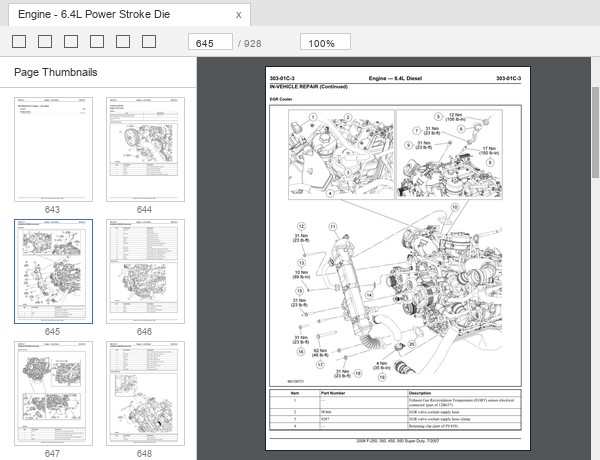
The 6.4L Power Stroke gets the largest share of the book: 928 pages in the engine section alone, with 183 more on fuel charging and controls and a further 105 on the turbocharger. Procedures are illustrated with exploded views, each fastener carries its torque figure in Nm and lb-ft, and the parts called out are listed by Ford part number underneath. The EGR cooler, the EGR valve and the emission control system all have their own coverage, as does the glow plug system, so the jobs these trucks are known for get full procedures and not a paragraph of advice.
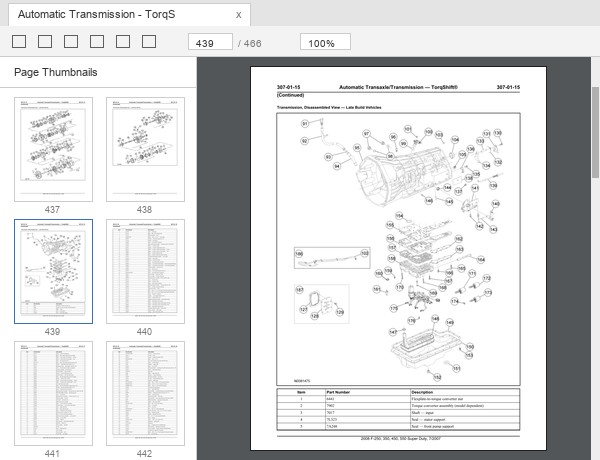
Driveline work is split by the axle actually fitted. Dana 80, Dana S110 and S130, and the Ford 10.50-inch ring gear each have their own section, with full-floating wheel hub and bearing coverage in both Dana and Ford forms. Four-wheel drive is treated as a system, and the transfer case is documented in manual-shift and electronic-shift versions. The TorqShift automatic runs to 466 pages including disassembled views of the case, valve body and pan, and the ZF 6-speed manual has its own section alongside the clutch and clutch controls.
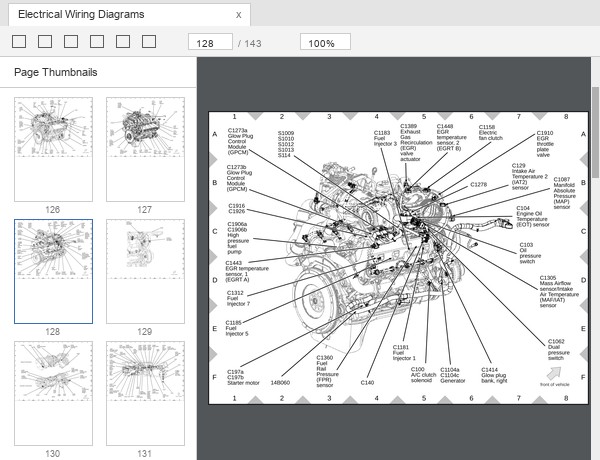
Body and chassis coverage is written for a working truck. The pickup bed and platform body section takes in chassis-cab and platform variants, and there are 101 pages of body repair work plus the full frame and body mounting section. Seating runs to 207 pages and the supplemental restraint system to 127. Electrical diagnosis is supported by the wiring diagram section, which locates connectors on the vehicle by grid reference and traces circuits through relays and fuses to their destination modules. The second sample page above is one of those diagrams.
Manual language and format
This manual is written in English and downloads as a ZIP containing 103 PDFs, foldered by system (Engine, Body, Brake System, Driveline, Wiring and so on), so you open the section you need instead of scrolling through one enormous file. Every PDF carries a text layer, so you can search for a section number, a torque figure or a connector identifier such as C1181 and jump straight to it. They open on Windows and Mac computers, tablets and phones, and pages print individually.
Questions about this manual
What are the common problems with a 2008 Ford F250?
This is Ford's repair manual, not a reliability guide, so it does not rank faults. What it does carry is full Diagnosis and Testing coverage for the areas owners of these trucks spend their time on, with DTC charts, symptom charts and pinpoint tests. That includes 183 pages on 6.4L fuel charging and controls, 105 on the turbocharger, the EGR and engine emission control section, the glow plug system, and ABS and stability control with its own pinpoint tests for the wheel speed sensor circuits.
What is the biggest problem with the 6.4 Powerstroke?
The manual does not name one, but it does give the full procedure for each of the parts that get talked about. The EGR cooler is documented in section 303-01C with an exploded view, the coolant hose and clamp listed by part number and every bolt given its torque figure. The turbocharger has a 105-page section of its own, and the high-pressure fuel system has 183 pages. Each one is a removal and installation procedure you can work through, not a description of how it functions.
Is a F250 expensive to maintain?
Not if you do the scheduled work yourself, which is what this manual is for. Ford's own Maintenance Schedules are included for both the gasoline and the diesel trucks, and the specification pages give the figures each job needs. The 6.4L takes 14.1 litres (15 quarts) of oil with the filter, runs 17.2:1 compression and fires 1-2-7-3-4-5-6-8. Lubricants, sealants and the special tools Ford specifies are named per section.
Who makes the best service manuals?
For any given vehicle the factory manual is the reference the aftermarket ones are condensed from. This is that document for the second-generation Super Duty. “Copyright 2007, Ford Motor Company” appears throughout, it is organised by Ford's own section numbering, and it calls out Ford special tools by number and Rotunda dealer test equipment by name, the way a dealer technician's copy does.
What is the towing capacity of a 2008 Ford F250 engine 5.4 L V8?
Towing and payload ratings live in Ford's owner literature and on the vehicle's own certification label, not in the workshop manual. What the manual gives you for the 5.4L is the repair side. Section 303-01A covers the engine across 356 pages, with 330 CID displacement, 9.8:1 compression and firing order 1-3-7-2-6-5-4-8 in the specifications, plus its own fuel charging, ignition and starting sections.
Which model years does this manual cover?
2008, 2009 and 2010. These are the second-generation Super Duty trucks, Ford's P356 platform, which ran from the 2008 redesign through to the end of 2010 before the 6.7L Power Stroke arrived for 2011. Ford dated the book to the launch year, so every page footer reads “2008 F-250, 350, 450, 550 Super Duty, 7/2007”, and the three engines it documents (5.4L Triton V8, 6.8L Triton V10 and 6.4L Power Stroke diesel) are the three this generation was sold with. One section sits outside that run: the 6.0L Power Stroke engine, whose footers read “2006 F-250, 350”. It is included complete, so owners of the earlier 6.0L get that engine covered too.
How you receive it
Payment is processed securely and the download link is issued immediately afterwards, so there is nothing to wait for and nothing shipped. The file is yours to keep and re-download within the link period.
Ford Expedition 2018-2021 Workshop Repair Manual
|
Ford Expedition
Compatible with: All Windows Systems |
Ford Expedition
Just £9.95
Instant Download |
This is Ford factory service documentation for the fourth-generation Expedition, supplied as a single PDF of 11,330 pages. It is organised the way Ford organises its own workshop information — by numbered section, so 307-01 is the automatic transmission, 417-01 is exterior lighting and 501-14 is handles, locks and latches. Each procedure carries its own revision date, and the wiring content is full colour.
Which vehicles this manual fits
- Fits: Ford Expedition, fourth generation (2018 onward), including Expedition MAX. A number of wiring and seating pages also carry Lincoln Navigator content
- Covers years: 2021, 2020, 2019, 2018
- Engine options: 3.5L EcoBoost, listed throughout as 3.5L EcoBoost (272kW/370PS), including the turbocharger sections
- Gearbox: 10R80 ten-speed automatic, with the transfer case and four-wheel drive systems covered separately
- Language: English
- Pages: 11,330 in a single PDF
- File type: PDF
Inside this manual
Every entry below is a numbered Ford section present in the document:
- 100-00 General Information
- 100-02 Jacking and Lifting
- 204-00 Suspension System – General Information
- 204-01A Front Suspension – RWD
- 204-01B Front Suspension – 4WD
- 204-02 Rear Suspension
- 204-04A Wheels and Tires
- 204-04B Tire Pressure Monitoring System
- 204-05 Vehicle Dynamic Suspension
- 205-01 Driveshaft
- 205-02A Rear Drive Axle/Differential
- 205-03 Front Drive Axle/Differential
- 205-05 Rear Drive Halfshafts
- 206-00 Brake System – General Information
- 206-03 Front Disc Brake
- 206-04 Rear Disc Brake
- 206-05 Parking Brake and Actuation
- 206-06 Hydraulic Brake Actuation
- 206-07 Power Brake Actuation
- 206-09 Anti-Lock Brake System
- 206-10 Auxiliary Brake System
- 211-02 Power Steering
- 211-04 Steering Column
- 211-05 Steering Wheel and Column Electrical Components
- 303-00 Engine System – General Information
- 303-01 Engine – 3.5L EcoBoost
- 303-03 Engine Cooling – 3.5L EcoBoost
- 303-04A Fuel Charging and Controls – 3.5L EcoBoost
- 303-04B Fuel Charging and Controls – Turbocharger
- 303-06 Starting System – 3.5L EcoBoost
- 303-07 Engine Ignition – 3.5L EcoBoost
- 303-08 Engine Emission Control – 3.5L EcoBoost
- 303-12 Intake Air Distribution and Filtering
- 303-13 Evaporative Emissions
- 303-14 Electronic Engine Controls
- 307-01 Automatic Transmission – 10R80
- 307-02 Transmission Cooling
- 307-05 Automatic Transmission External Controls
- 308-07B Transfer Case
- 308-07A Four-Wheel Drive Systems
- 309-00 Exhaust System
- 310-00 Fuel System – General Information
- 412-00 Climate Control System – General Information
- 412-02 Rear Climate Control
- 413-01 Instrumentation
- 414-00 Charging System – General Information
- 414-01 Battery, Mounting and Cables
- 414-02 Generator and Regulator
- 414-05 Voltage Converter/Inverter
- 414-06 Accessory Charging
- 415-00 Information and Entertainment System
- 417-01 Exterior Lighting
- 417-02 Interior Lighting
- 418-00 Module Communications Network
- 418-01 Module Configuration
- 419-01A Perimeter Anti-Theft Alarm
- 419-01B Passive Anti-Theft System
- 419-02 Remote Convenience
- 419-03A Cruise Control
- 419-03C Collision Warning and Collision Avoidance
- 419-04 Side and Rear Vision
- 419-07 Lane Keeping System
- 419-10 Multifunction Electronic Modules
- 501-00 Body System – General Information
- 501-02 Front End Body Panels
- 501-03 Body Closures
- 501-05 Interior Trim and Ornamentation
- 501-08 Exterior Trim and Ornamentation
- 501-09 Rear View Mirrors
- 501-10A Front Seats
- 501-10B Second Row Seats
- 501-10C Third Row Seats
- 501-11 Glass, Frames and Mechanisms
- 501-12 Instrument Panel and Console
- 501-14 Handles, Locks, Latches and Entry Systems
- 501-16 Wipers and Washers
- 501-17 Roof Opening Panel
- 501-19 Bumpers
- 501-20A Seatbelt Systems
- 501-20B Supplemental Restraint System
- 501-25 Body Repairs – General Information
- 501-28 Roof Sheet Metal Repairs
- 501-29 Side Panel Sheet Metal Repairs
- 501-30 Rear End Sheet Metal Repairs
- 502-02 Full Frame and Body Mounting
Sample pages from this manual
These are real pages taken from the document:
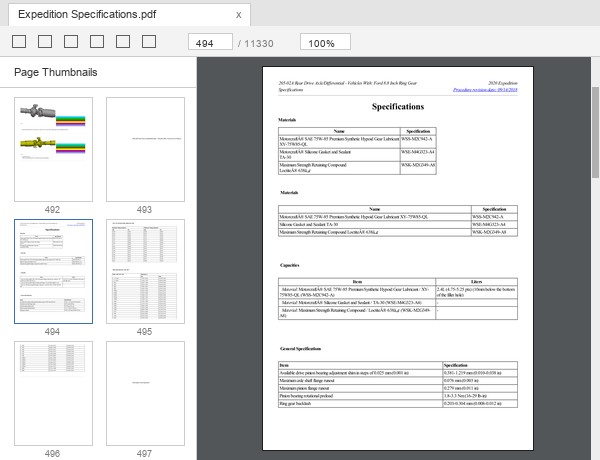
What you can repair with it
Powertrain work centres on the 3.5L EcoBoost and the 10R80 ten-speed automatic. The transmission section is the most heavily referenced in the whole document and includes the Adaptive Learning Drive Cycle as a general procedure, so a rebuild or valve body job can be finished properly rather than left to relearn on its own. Turbocharger, fuel charging, intake air and evaporative emissions each have their own section.
Chassis coverage separates front suspension into rear-wheel drive and four-wheel drive versions, and adds Vehicle Dynamic Suspension for air-sprung cars — including the Ride Height Calibration routine that has to be run after replacing a suspension height sensor. Brakes run from general information through front and rear discs, hydraulic and power actuation, anti-lock control and the auxiliary brake system.
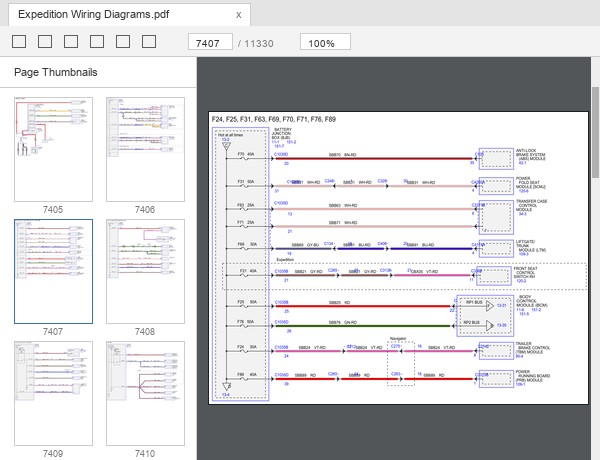
Electrical work is where the page count goes. Module Communications Network and Multifunction Electronic Modules are both large sections, backed by full colour power distribution diagrams that show fuse numbers, circuit identifiers and wire colours down to each destination module. Driver assistance is covered too — lane keeping, side and rear vision, collision warning and the parking aid variants. Body repair extends to roof, side panel and rear end sheet metal work with tolerance checking.
Manual language and format
This manual is written in English and downloads as a single PDF. It carries a text layer, so you can search it for a section number, a circuit identifier or a torque figure and jump straight there rather than paging through it. It opens on Windows and Mac computers, tablets and phones, and individual pages print normally.
Questions about this manual
How do I reset the air suspension system?
With a scan tool, using the Ride Height Calibration routine. The manual calls for it in several places — after replacing a suspension height sensor, after work on the Vehicle Dynamic Module, and as the closing step of several suspension procedures — and the instruction is to connect the scan tool, run Ride Height Calibration and follow the tool's directions. The Vehicle Dynamic Suspension section covers the sensors, the air springs and the module behind it.
How do you reset a Ford transmission's adaptive learning?
By running the Adaptive Learning Drive Cycle, which is a general procedure inside the 10R80 automatic transmission section. Where a repair also requires new software, the manual pairs it with a transmission strategy download and then the drive cycle, and it tells you which repairs need both. This is the step that determines whether shift quality settles down after a transmission job.
Why is my Ford Expedition so bouncy?
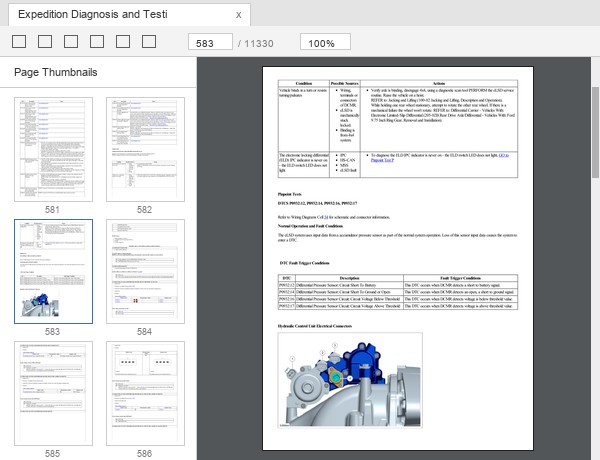
The suspension section diagnoses ride complaints by symptom rather than by guesswork. “Rough or harsh ride”, “vehicle leans to” one side and squeak, creak or rattle noises from the front or rear suspension each have their own entry listing the possible sources and the action to take, and air-sprung cars are separated from conventionally sprung ones so you are not chasing a fault in the wrong system.
Which model years does this manual cover?
It is Ford's workshop information for the fourth-generation Expedition, which ran from 2018 to 2021 with the same 3.5L EcoBoost engine and 10R80 transmission throughout. The document itself is the 2020 model year edition — its page headers read “2020 Expedition” — and individual procedures carry revision dates running from 2012 to 2020.
Which engine and gearbox are covered?
The 3.5L EcoBoost, named throughout as 3.5L EcoBoost (272kW/370PS), and the 10R80 ten-speed automatic. The transfer case and four-wheel drive systems are documented in their own sections, so both rear-wheel drive and four-wheel drive cars are served.
Are wiring diagrams included?
Yes, in full colour. The power distribution diagrams show the battery junction box and each fuse by number, the circuit identifier and wire colour on every branch, and the destination module for each feed — anti-lock brakes, body control, transfer case, trailer brake control and so on. The first sample page above is one of them.
How you receive it
Payment is processed securely and the download link is issued immediately afterwards, so there is nothing to wait for and nothing shipped. The file is yours to keep and re-download within the link period.