Terms of Use — Digital Workshop Manuals
Last updated: 30 July 2026
These Terms of Use govern the purchase and use of digital workshop manuals, service guides and related digital products ("Manuals") sold on downloadworkshopmanuals.com (the "Store"). By purchasing or downloading a Manual you agree to these terms.
1. What you are buying
Each Manual is a digital publication (typically PDF or software) containing vehicle service, repair and maintenance information for the vehicle model(s) and year range stated on the product page. Manuals are delivered electronically — no physical item is shipped.
2. Licence of use
Your purchase grants you a personal, non-exclusive, non-transferable licence to download, store, view and print the Manual for your own vehicle repair and workshop use (private or professional). You may keep backup copies for your own use.
3. What you may not do
You may not resell, redistribute, share, publish, upload to file-sharing services, sublicense, rent or otherwise make the Manual available to any third party. The licence is for the purchaser only.
4. Trademarks and manufacturer names
Vehicle manufacturer names, logos and model designations (for example Ford, BMW, Toyota) are trademarks of their respective owners. They are used on this Store solely to identify vehicle compatibility of the Manuals. This Store is an independent retailer and is not affiliated with, endorsed by or sponsored by any vehicle manufacturer.
5. Delivery and re-delivery
Download links are provided immediately after payment. If a link expires or a file fails to download, contact support and we will re-issue your download at no charge.
6. Refunds
Because Manuals are digital goods delivered instantly, refunds are provided where the downloaded item is faulty, materially not as described, or cannot be successfully delivered after support assistance. See our Refund Policy for full details. Where a purchase is processed by an authorised merchant-of-record partner, that partner's refund process applies alongside this policy.
7. Repair disclaimer
Manuals are provided for information purposes. Vehicle repair involves risk; always follow the safety procedures described and use appropriate tools and protective equipment. To the maximum extent permitted by law, the Store is not liable for damage, injury or loss arising from repair work carried out using a Manual.
8. Support and contact
Questions about these terms or any purchase: This email address is being protected from spambots. You need JavaScript enabled to view it. or via the Store contact page.
Ford Explorer 2016-2019 Workshop Repair Manual
|
Ford Explorer
Compatible with: All Windows Systems |
Ford Explorer
Just £9.95
Instant Download |
This is Ford's service information for the facelifted fifth generation Explorer, the U502 as it was sold from 2016 through 2019. It arrives as seven PDFs totalling 25,499 pages, and the workshop volume alone runs to 100 of Ford's numbered sections.
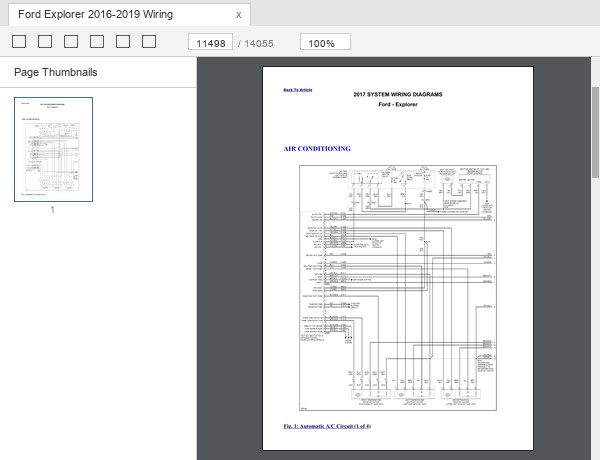
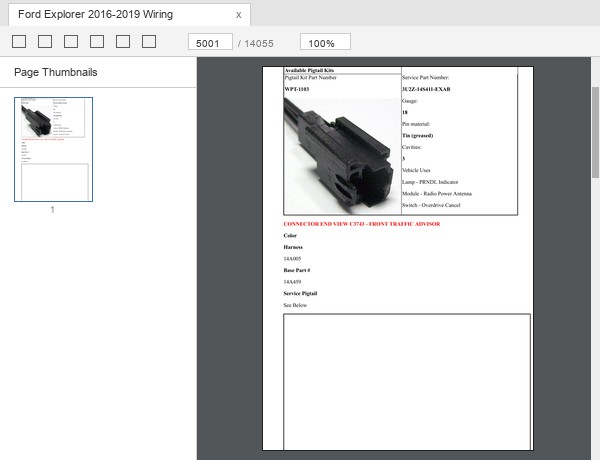
This set includes the wiring diagrams. That is worth saying plainly, because it is the part most downloads leave out. You get 1,653 circuit drawings in Ford's own colour format, wire colours and gauges marked, and 591 connector end views that name the colour, the harness number, the base part number and the pigtail kit for each plug. Alongside them sit the component harness location charts, so you can find the connector on the car before you probe it.
Read this before buying so you know exactly what you are getting. Two things to be clear about. This is a set of seven separate PDFs in one download, not a single file, so you pick the volume first and search within it. And the data set is the 2017 model year, sitting in the middle of the 2016 to 2019 run, which is how Ford issued it: the 2016 facelift and the 2019 run-out share this material. The owner and warranty books included with it are the North American editions.
Which vehicles this manual fits
- Fits: Ford Explorer, fifth generation U502 after the 2016 facelift, front wheel drive and four wheel drive. The Police Interceptor Utility is covered throughout, not as an afterthought
- Covers years: 2019, 2018, 2017, 2016
- Engine options: the 2.3L EcoBoost four cylinder (201kW/273PS), the 3.5L Duratec Ti-VCT V6 (209kW/284PS), the 3.5L EcoBoost twin turbo V6 fitted to the Sport and Platinum (257kW/350PS), and the 3.7L Duratec V6 (227kW/301PS) that only the Police Interceptor Utility got
- Gearbox: the 6F35 and 6F50/6F55 six speed automatics, with the power transfer unit, four wheel drive system, external controls and transmission cooling
- Wiring: included. 1,653 circuit figures, 591 connector end views, component harness location charts and views, and the full pin-out data
- Diagnostics: 2,614 pinpoint tests, 2,794 distinct diagnostic trouble codes with a dedicated DTC index, plus component testing for the anti-lock brakes and the electric power steering
- Also included: Ford's 2017 Powertrain Control and Emissions Diagnosis book, 1,395 pages on its own, the 545 page owner's manual, the quick reference card and the warranty guides
- Language: English
- Pages: 25,499 across seven PDFs
- File type: ZIP archive holding seven PDFs, 740 MB
Inside this manual
The workshop volume follows Ford's numbered sections. Below is what the set holds across all seven books, grouped the way you would go looking for it.
- General Information and how the sections are numbered
- Identification Codes
- Jacking and Lifting
- Maintenance Schedules
- Noise, Vibration and Harshness
- Police Equipment
- Engine System, general information
- Engine, 2.3L EcoBoost
- Engine, 3.5L Duratec Ti-VCT
- Engine, 3.5L EcoBoost
- Engine Overhaul Procedures
- Engine Cooling, per engine
- Accessory Drive
- Starting System
- Engine Ignition
- Engine Emission Control
- Evaporative Emissions
- Intake Air Distribution and Filtering
- Fuel Charging and Controls, per engine
- Turbocharger, 2.3L and 3.5L EcoBoost
- Electronic Engine Controls, per engine
- Electronic Engine Controls, 3.7L Duratec
- Exhaust System
- Fuel System, general information
- Fuel Tank and Lines
- Acceleration Control
- Engine Controls, description and operation
- Engine Controls, pinpoint tests
- Powertrain DTC charts and descriptions
- State emission standards and abbreviations
- 6F35 six speed automatic transmission
- 6F50 and 6F55 six speed automatic transmission
- Automatic Transmission External Controls
- Transmission Cooling
- Power Transfer Unit
- Four-Wheel Drive Systems
- Driveshaft
- Rear Drive Axle and Differential
- Front and Rear Drive Halfshafts
- Suspension System, general information
- Front Suspension
- Rear Suspension
- Wheels and Tires
- Tire Pressure Monitoring System (TPMS)
- Ford wheel alignment specifications
- Brake System, general information
- Front Disc Brake
- Rear Disc Brake
- Parking Brake and Actuation
- Hydraulic Brake Actuation
- Power Brake Actuation
- Anti-Lock Brake System (ABS) and Stability Control
- Anti-lock brake component testing
- Power Steering
- Electric power assist steering component testing
- Steering Column
- Steering Wheel and Column Electrical Components
- Charging System, general information
- Battery, Mounting and Cables
- Generator and Regulator
- Voltage Converter and Inverter
- Climate Control System, general information
- Rear Climate Control
- Instrumentation, Message Center and Warning Chimes
- Instrument Panel and Interior Switches Illumination
- Horn
- Exterior Lighting
- Interior Lighting
- Information and Entertainment System, all four SYNC fitments
- Module Communications Network
- Module Configuration and programming
- Multifunction Electronic Modules
- Perimeter Anti-Theft Alarm
- Passive Anti-Theft System (PATS) and keyless vehicle system
- Remote Convenience
- Cruise Control and Adaptive Cruise Control
- Collision Warning and Collision Avoidance System
- Lane Keeping System
- Side and Rear Vision
- Parking Aid, rear sensors, camera and Active Park Assist
- Body System, general information
- Front End Body Panels
- Body Closures
- Bumpers
- Glass, Frames and Mechanisms
- Handles, Locks, Latches and Entry Systems
- Roof Opening Panel
- Rear View Mirrors
- Wipers and Washers
- Exterior and Interior Trim and Ornamentation
- Instrument Panel and Console
- Front Seats, Second Row Seats, Third Row Seats
- Seatbelt Systems
- Supplemental Restraint System
- Body Repairs, general and vehicle specific tolerance checks
- Front End, Roof, Side Panel and Rear End Sheet Metal Repairs
- Paint, general information
- Uni-Body, Subframe and Mounting System
- System wiring diagrams, all circuits
- OEM connector end views
- Component harness location charts and views
- DTC index for Explorer and Police Interceptor Utility
- Service reminder indicator reset procedures
- Trouble shooting, basic procedures
Every system section carries the same four parts: specifications, description and operation, diagnosis and testing, then removal and installation with the torque figures written against the fastener they belong to.
Sample pages from this manual
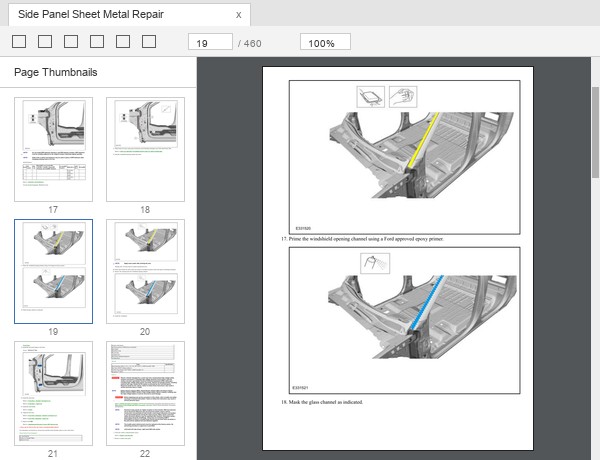
Three pages taken straight from the set, one from each of the volumes you will spend time in:
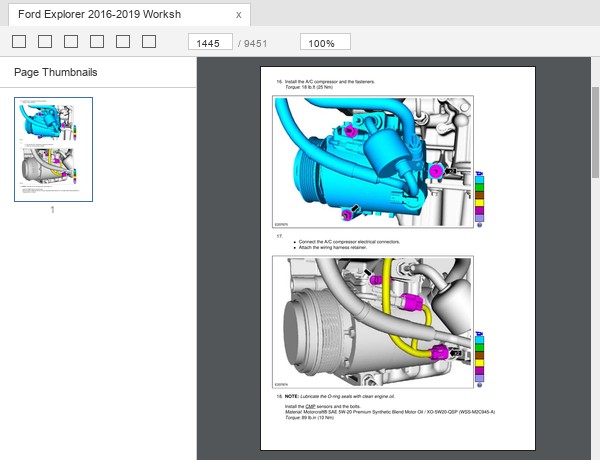
What you can repair with it
Start with the electrical, because that is where this set pulls away from anything else at the price. A fault that reaches a connector normally stops most downloads dead. Here you have the circuit drawing, the connector end view showing which cavity is which, the harness location chart telling you where the plug lives on the car, and the pinpoint test telling you what the meter should read. Four pieces of information that only work together, and all four are present.
Four engines are documented, and the one people usually cannot find is here: the 3.7L Duratec that Ford fitted only to the Police Interceptor Utility, with its own electronic engine controls and exhaust sections. The 2.3L EcoBoost, the 3.5L Duratec and the 3.5L EcoBoost each get full engine, cooling, ignition, starting, emissions, intake and fuel charging chapters, and the two EcoBoosts have separate turbocharger sections.
Both six speed automatics are treated properly. The 6F35 behind the four cylinder and the 6F50/6F55 behind the V6 each get overhaul, external controls and cooling coverage, and the power transfer unit and four wheel drive system are documented alongside them. A dry fill is 11 quarts, 10.3 litres, of Motorcraft MERCON LV to WSS-M2C938-A.
The 2017 Powertrain Control and Emissions Diagnosis book that comes with the set is a serious document in its own right, 1,395 pages of diagnostic method, symptom charts, powertrain DTC descriptions and reference values. If a check engine light is what brought you here, that volume plus the pinpoint tests is the whole job.
Body and collision work is complete: front end, roof, side panel and rear end sheet metal repairs, the vehicle specific tolerance checks for measuring a bent shell, the subframe and uni-body mounting section, and the paint general information. Trim, glass, seats in all three rows, the roof opening panel and the restraint systems are all in the workshop volume.
Driver assistance is covered module by module for the fitments this generation offered: adaptive cruise, collision warning and avoidance, lane keeping, active park assist, the rear camera and the side and rear vision systems. Module configuration is documented, which matters because a replacement module on this car has to be configured before it will do anything.
There is also a set of things that rarely make it into a download at all: Ford's wheel alignment specification tables, the service reminder indicator reset procedures, the anti-lock brake and electric power steering component tests, and a dedicated DTC index for the Explorer and the Police Interceptor Utility.
Manual language and format
The whole set is in English, Ford's North American edition.
The download is a ZIP archive holding seven PDFs, about 740 MB in total, and you extract it before use. They are numbered so the order is obvious: the workshop manual first, then the wiring diagrams and connector views, then the powertrain diagnosis book, then the owner and warranty material. Search runs inside whichever volume you have open, so the habit to get into is picking the volume before you type.
The files have been cleaned up before packaging. Metadata is stripped, nothing carries a password, printing and copying are enabled, and the page furniture that files of this kind pick up on their way around the internet has been taken out, including the vehicle identification number of the car the original export was generated against. What is left is Ford's own pages.
One cosmetic thing you will notice: some illustrated pages in the workshop volume carry a small strip of colour swatches in the right margin, a leftover from the viewer Ford's own service site draws them in. It sits outside the text and affects nothing, and we would rather mention it than have you wonder.
Nothing to install and nothing to activate. Any PDF reader opens the volumes, on a workshop laptop, a Mac, an iPad or a phone.
Questions about this manual
Are the wiring diagrams really included?
Yes, and they are the reason to buy this one. 1,653 circuit figures in Ford's colour format with wire colours and gauges marked, 591 connector end views giving the colour, harness number, base part number and pigtail kit, and the component harness location charts that tell you where on the car to find the plug.
Will it fit my 2015 Explorer, or my 2020?
Neither. The 2015 is the pre-facelift car with a different front end and the 2.0L EcoBoost, and the 2020 is the completely different rear drive U625 redesign. This one is the 2016 to 2019 facelift, and we sell manuals for the other two separately.
Is the Police Interceptor Utility included?
Properly, yes. The 3.7L Duratec V6 that only the police car used has its own sections, Ford's Police Equipment section is in the workshop volume, and the wiring diagrams, connector views and DTC index are all titled for the Explorer and the Police Interceptor Utility together.
Which SYNC versions are covered?
All four fitments Ford offered across the run get their own information and entertainment sections, SYNC 3 included, along with the module communications network and module configuration procedures.
How much oil and transmission fluid does it take?
Engine oil is 6.0 quarts, 5.68 litres, on a service fill including the filter. The automatic takes 11 quarts, 10.3 litres, for a dry fill of Motorcraft MERCON LV. Both figures come out of the specification tables, and every other capacity is in section 100-00.
Is it one file?
No, seven, in one ZIP. That is deliberate: the wiring diagrams and the workshop procedures are separate documents in Ford's own material and keeping them apart is how the cross-references work.
Does the owner's manual come with it?
It does, all 545 pages, plus the quick reference card and the warranty guides. They cost nothing to include and they answer the questions a workshop manual does not, like what a particular warning light means before you go looking for a fault.
Why buy this instead of a shop manual off the shelf?
A shelf book gives you a couple of hundred pages spread across several model years, written from the outside. This is 25,499 pages of what Ford issues to its own dealer network for one vehicle. Each of the four engines has its own chapters instead of one shared summary. Torque figures sit inline with the step, against the exact fastener, in both Newton metres and pound feet. Diagnosis runs on Ford's own pinpoint trees, 2,614 of them, naming the connector and the expected reading at every branch. And it carries the two things a general book never has: the complete wiring diagrams with connector end views, and the collision and sheet metal repair specifications with the tolerance checks. For less than the price of one paper manual you are reading what the dealer technician reads.
How you receive it
Payment is taken securely and the download link is issued as soon as it clears, normally inside a minute. There is nothing to post and no disc to wait for. The link stays live, so the file can be pulled down again later if you need it on another machine.
Ford F-150 2021-2023 Workshop Repair Manual
|
Ford F-150
Compatible with: All Windows Systems |
Ford F-150
Just £9.95
Instant Download |
This is the factory service information for the fourteenth generation F-150, the aluminium-bodied truck Ford launched for 2021 with six engines and a hybrid at the top of the range. It runs to 20,777 pages and is supplied as 222 separate section PDFs in one download.
The emission applications table inside is headed 2021 F150 and lists the engines Ford sold that year. That is how we date the book, and the 3.0L Power Stroke diesel it documents was a 2021-only engine, which fixes the year beyond doubt.
Read this before buying so you know exactly what you are getting. Two things are worth knowing up front. This download is 222 separate PDFs, one per section, not a single file, so you search within a section rather than across the whole book. And it holds no wiring schematics. The diagnostics are here in full, including pinpoint tests and connector numbers, but the circuit drawings themselves sit in a separate Ford module that is not part of this release. The section below on language and format explains both in plain terms.
Which vehicles this manual fits
- Fits: Ford F-150, fourteenth generation, in Regular Cab, SuperCab and SuperCrew form, 4x2 and 4x4. SuperCrew is the body style named most often throughout
- Covers years: 2023, 2022, 2021
- Engine options: 2.7L EcoBoost (238 kW / 324 PS), 3.5L EcoBoost, 3.5L PowerBoost full hybrid V6, 5.0L Ti-VCT 32-valve V8, 3.3L Duratec V6 and the 3.0L Power Stroke turbo diesel. All six have their own engine, cooling, fuel and controls sections
- Gearbox: the 10R80 ten-speed automatic, plus the 10R80 MHT modular hybrid version fitted behind the PowerBoost, each with its own overhaul and external controls coverage
- Driveline: Ford 8.8 inch and 9.75 inch rear axles, the electronic locking differential, front halfshafts, transfer case and the four-wheel drive systems
- Body: the aluminium body, with the collision chapters covering front end, rear end, roof and side panel sheet metal, bonding, riveting and paint
- Language: English
- Pages: 20,777 across 222 section PDFs
- Wiring: no circuit schematics. Pinpoint tests, connector numbers and module coverage are present in quantity
- File type: ZIP archive of PDFs, 626 MB
Inside this manual
Every entry below is a subsystem the document covers under its own heading:
- Engine, overview and in-vehicle repair, all six engines
- Engine System, general information
- Accessory Drive
- Engine Cooling
- Engine Ignition
- Exhaust System
- Fuel System, general information
- Fuel Tank and Lines
- Starting System
- Glow Plug System, 3.0L Power Stroke diesel
- Electric Motor and Electric Powertrain Cooling
- Electric Powertrain Control, PowerBoost hybrid
- Electronic Engine Controls
- Fuel Charging and Controls, including the turbochargers
- Intake Air Distribution and Filtering
- Engine Emission Control
- Evaporative Emissions
- Acceleration Control
- Engine Controls, description, operation and diagnostic methods
- Engine Controls, pinpoint tests
- Powertrain DTC charts and descriptions
- Engine Controls, reference values and symptom charts
- Firing order and cylinder identification
- Emission applications, abbreviations and state standards
- 10R80 ten-speed automatic transmission
- 10R80 MHT modular hybrid transmission
- Automatic Transmission External Controls
- Transmission Cooling
- Four-Wheel Drive Systems
- Transfer Case
- Driveshaft
- Front Drive Axle Differential and Halfshafts
- Rear Drive Axle Differential, Ford 8.8 inch ring gear
- Rear Drive Axle Differential, Ford 9.75 inch ring gear
- Wheel Hubs and Bearings
- Brake System, general information
- Front and Rear Disc Brake
- Hydraulic and Power Brake Actuation
- Parking Brake and Actuation
- Anti-Lock Brake System (ABS) and Stability Control
- Auxiliary Brake System, trailer braking
- Power Steering
- Steering Column
- Suspension System, general information
- Front Suspension, 4WD and RWD
- Rear Suspension
- Wheels and Tires
- Tire Pressure Monitoring System (TPMS)
- Wheel alignment specifications
- Battery, Mounting and Cables
- Charging System, generator and accessory charging
- High Voltage Battery, Mounting and Cables
- Voltage Converter Inverter
- Body System, general information
- Body Closures
- Bumpers
- Front End Body Panels and Full Frame Mounting
- Pickup Bed and Platform Body
- Glass, Frames and Mechanisms
- Handles, Locks, Latches and Entry Systems
- Exterior and Interior Trim and Ornamentation
- Front Seats and Rear Seats
- Instrument Panel and Console
- Roof Opening Panel and Rear View Mirrors
- Wipers, Washers and Horn
- Exterior Lighting
- Interior Lighting
- Instrumentation, Message Center and Warning Chimes
- Information and Entertainment System
- Controller Area Network (CAN) module communications
- Ethernet network and over-the-air module programming
- Multifunction Electronic Modules
- Passive Anti-Theft System (PATS) and perimeter alarm
- Remote Convenience
- Cruise Control and Adaptive Cruise Control
- Parking Aid, Active Park Assist and Trailer Back Up Assist
- Collision Warning and Collision Avoidance
- Lane Keeping System
- Pedestrian Alert, Interior Camera, Side and Rear Vision
- Steering Wheel and Column Electrical Components
- Climate Control System and supplemental heating
- Seatbelt Systems and Supplemental Restraint System
- Body dimensions, construction and sheet metal repairs
- Paint and Coatings
- Collision inspection and repair procedures
Sample pages from this manual
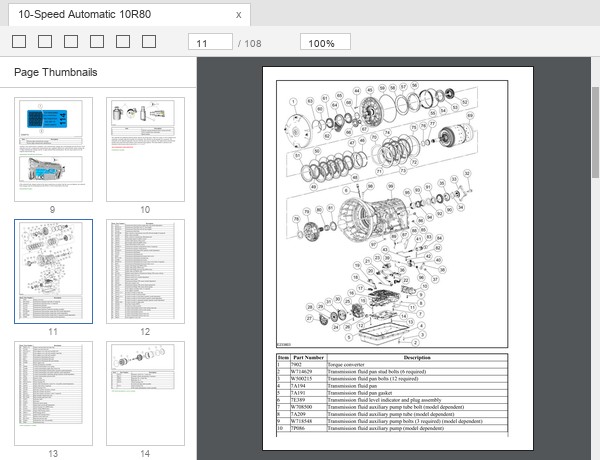
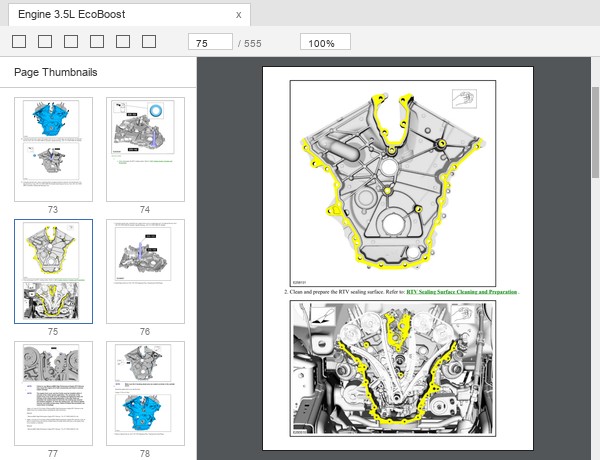
These are real pages taken from the document, so you can see exactly what you are buying:
What you can repair with it
The diagnostic material is the heart of this set. Pinpoint tests are referenced more than 13,000 times across the sections, along with powertrain DTC charts, symptom charts and reference values. A pinpoint test is Ford's structured fault tree: it names the connector to probe, the reading to expect and the branch to follow from each result. That is what separates finding a fault from replacing parts and hoping.
Engine coverage is complete and separate for every unit Ford offered that year. The 2.7L and 3.5L EcoBoost, the 3.3L Duratec, the 5.0L Ti-VCT V8, the 3.0L Power Stroke diesel and the 3.5L PowerBoost hybrid each get their own removal, overhaul and installation chapters, with the torque figures quoted inline against the fastener they belong to. The illustrations are Ford's own, colour coded so the part being worked on is picked out in yellow and the fastener in magenta.
The hybrid material is worth calling out. The PowerBoost brings a high voltage battery, an electric motor built into the bellhousing, a voltage converter inverter and the 10R80 MHT transmission, and all four have their own sections. High voltage battery procedures alone are referenced 862 times. If you are working on a PowerBoost this is the coverage you need and it is rarely present in aftermarket books.
Body and collision repair runs deeper here than on most trucks. The panels are aluminium and bonded in places a steel truck would be welded, so the sheet metal chapters give the bonding adhesive by part number, the rivet pattern and the sequence for front end, rear end, roof and side panel work. Body dimensions and construction are documented for measuring a damaged shell.
Driver assistance is covered module by module: adaptive cruise, lane keeping, collision warning and avoidance, active park assist, trailer back-up assist, the pedestrian alert system the hybrid needs, and the interior camera. Module configuration and over-the-air programming are documented, which matters on a truck of this generation because a replaced module has to be configured before it will work.
Manual language and format
English is the only language in the set. The download is a ZIP archive holding 222 PDFs, one for each section, and you extract it before use. That shape has a practical consequence worth understanding: search works inside whichever section you have open, so you go to the section first and search within it, instead of typing a part number once and searching all 20,777 pages at once. Sections are named plainly, so finding the right one is quick.
The content is Ford's own service information, licensed and reissued in this form, with the data set current to 2023. The illustrations carry Ford's figure numbers and the note "Courtesy of FORD MOTOR COMPANY", and the procedures are Ford's, with Ford part numbers and Ford torque figures throughout. It is not a file exported by Ford itself, which is worth stating plainly because some of our other F-150 listings are exactly that.
Two limitations to be aware of. There are no wiring schematics: the pinpoint tests reference connector numbers such as C2280G-6 and the diagnosis assumes you can look the circuit up, but the drawings live in a separate module that is not in this release. And the registered trademark and degree symbols did not survive the conversion cleanly, so Motorcraft and MERCON read with a stray capital letter in front of the symbol in the specification tables. It does not affect any figure, torque value or procedure, and we would rather point it out than have you find it.
Nothing installs and nothing needs activating. Any PDF reader opens the sections, on a workshop laptop, a Mac, a tablet or a phone.
Questions about this manual
Will it cover my 2024 F-150?
No. The 2024 truck is the facelift, with a different grille and headlights, the 3.3L V6 dropped and the 2.7L EcoBoost made standard. None of that is in this book. It covers the 2021 to 2023 run before that change.
Does it include the diesel?
Yes, and that is a good marker for the years. The 3.0L Power Stroke was only sold in the 2021 F-150 before Ford discontinued it, and this set carries its engine, cooling, fuel, glow plug and controls sections in full.
Are wiring diagrams included?
No. This is the one thing to know before buying. Diagnosis, pinpoint tests, DTC charts, connector numbers and module coverage are all present, but the circuit drawings are not part of this release. If schematics are what you need, this set on its own will not give you them.
How much fluid does the 10R80 take?
The specification table gives 13.7 quarts, 13 litres, for a completely dry transmission and torque converter, using Motorcraft MERCON ULV to WSS-M2C949-A. The manual notes that a drain and refill takes less than a full dry fill.
Does the 2021 F-150 have transmission problems?
A workshop manual does not rank reliability, so we will not pretend it answers that. What it does give you is the 10R80 in four parts: diagnosis, in-vehicle service, full overhaul with the exploded views and part numbers, and the external controls, plus a separate set for the 10R80 MHT behind the hybrid.
Does it cover the PowerBoost hybrid?
Yes. The electric motor, high voltage battery and cables, the voltage converter inverter, electric powertrain cooling and control, and the 10R80 MHT transmission each have their own sections.
How does this compare with a Haynes or Chilton book?
There is no real comparison. Those books give you a few hundred pages stretched across a whole model range. This is 20,777 pages written for this truck by the people who built it. All six engines get their own full chapters instead of one shared summary, so you are reading the procedure for your engine, not the closest approximation. Every torque figure is Ford's own and sits inline with the step, against the exact fastener, so you are never hunting a specification table at the back. Diagnosis runs on Ford's pinpoint tests, referenced more than 13,000 times, which name the connector to probe and the reading to expect at every branch, so you follow a decision tree to the fault instead of working through a list of likely causes. The illustrations are Ford's, colour coded so the part you are touching is picked out on the page. You also get the chapters an aftermarket book will not carry at all: the PowerBoost hybrid and its high voltage system, the 10R80 stripped to its last circlip, and the aluminium body and collision work with the bonding and rivet specifications. For the price of a paper manual you get what the dealer technician works from.
How you receive it
Checkout is secure and the download link arrives once payment clears. Nothing is posted and there is no disc. The link stays live, so you can pull the archive down again whenever you need it.
Ford Explorer 2020-2022 Workshop Repair Manual
|
Ford Explorer
Compatible with: All Windows Systems |
Ford Explorer
Just £9.95
Instant Download |
This is Ford's own service information for the sixth generation Explorer, the U625 that arrived for 2020 on a new rear wheel drive platform. It runs to 15,467 pages in a single searchable PDF and is organised by Ford's own section numbering, 152 numbered sections in all.
The 2020 redesign changed almost everything underneath. The Explorer went back to a longitudinal, rear drive layout, gained a ten speed automatic and picked up a hybrid for the first time. Every one of those systems is documented here in the same detail Ford gives a dealer technician.
Read this before buying so you know exactly what you are getting. One thing worth knowing up front: this set holds no wiring schematics. What it does hold is the diagnostic half in full, with more than six thousand pinpoint test references, 1,289 diagnostic trouble codes and over forty thousand connector references with pin-out tables giving pin, circuit, gauge and qualifier. If circuit drawings are specifically what you need, this book on its own will not give you them. Everything else about the car is here.
Which vehicles this manual fits
- Fits: Ford Explorer, sixth generation U625, in rear wheel drive and all wheel drive form. Ford's separate Police Equipment section is included
- Covers years: 2022, 2021, 2020
- Engine options: the 2.3L EcoBoost four cylinder, the 3.0L EcoBoost twin turbo V6 fitted to the ST, the naturally aspirated 3.3L Duratec V6, and the 3.3L hybrid. All four are documented separately, each with its own engine, cooling, fuel charging, ignition, starting, emission control, intake and electronic controls sections
- Hybrid: the electric motor, electric powertrain cooling, electric powertrain control, the high voltage battery with its mounting and cables, and the voltage converter and inverter all have sections of their own
- Gearbox: the 10R60 and 10R80 ten speed automatics, with transmission, transfer case and power transfer unit coverage plus external controls and cooling
- Driveline: transfer case, four wheel drive systems, driveshaft, front and rear drive axles and differentials, and the front drive halfshafts
- Suspension: separate front suspension sections for rear wheel drive and all wheel drive, rear suspension, wheels and tyres, and the tyre pressure monitoring system
- Diagnostics: 6,157 pinpoint test references, 1,289 distinct trouble codes and 44,167 connector references
- Wiring: no circuit schematics. Connector pin-out tables, connector numbers and module diagnosis are present throughout
- Language: English
- Pages: 15,467 in one PDF
- File type: PDF, 714 MB
Inside this manual
Ford splits its service information into numbered sections. Below is what this set holds, listed the way the book itself organises it. Where a system differs by engine or by drivetrain, Ford writes a separate section for each, and all of those separate sections are present.
- General Information, and how to use the section numbering
- Identification Codes
- Jacking and Lifting
- Maintenance Schedules
- Noise, Vibration and Harshness
- Police Equipment, the Police Interceptor Utility fitment
- Engine System, general information
- Engine, 2.3L EcoBoost
- Engine, 3.0L EcoBoost
- Engine, 3.3L Duratec V6
- Engine, 3.3L Duratec V6 hybrid
- Electric Motor
- Engine Cooling, one section per engine
- Electric Powertrain Cooling, hybrid
- Fuel Charging and Controls, one section per engine
- Turbocharger, 2.3L and 3.0L EcoBoost
- Accessory Drive, one section per engine
- Starting System, one section per engine
- Engine Ignition, one section per engine
- Engine Emission Control, one section per engine
- Evaporative Emissions, one section per engine
- Intake Air Distribution and Filtering, one section per engine
- Electronic Engine Controls, one section per engine
- Electric Powertrain Control, hybrid
- Exhaust System, one section per engine
- Fuel System, general information, one section per engine
- Fuel Tank and Lines, one section per engine
- Acceleration Control
- 10R60 ten speed automatic, transmission, transfer case and power transfer unit
- 10R80 ten speed automatic, transmission, transfer case and power transfer unit
- 10R80 MHT modular hybrid transmission
- Automatic Transmission External Controls, all three gearboxes
- Transmission Cooling, all three gearboxes
- Four-Wheel Drive Systems
- Transfer Case
- Driveshaft
- Front Drive Axle and Differential
- Rear Drive Axle and Differential
- Front Drive Halfshafts
- Rear Drive Halfshafts
- Suspension System, general information
- Front Suspension, rear wheel drive
- Front Suspension, all wheel drive
- Rear Suspension
- Wheels and Tires
- Tire Pressure Monitoring System (TPMS)
- Brake System, general information
- Front Disc Brake
- Rear Disc Brake
- Hydraulic Brake Actuation
- Power Brake Actuation
- Parking Brake and Actuation
- Anti-Lock Brake System (ABS) and Stability Control
- Power Steering
- Steering Column
- Steering Wheel and Column Electrical Components
- Charging System, general information
- Battery, Mounting and Cables
- Generator and Regulator
- High Voltage Battery, Mounting and Cables
- Voltage Converter and Inverter
- Accessory Charging
- Climate Control System, general information
- Rear Climate Control
- Supplemental Climate Control
- Instrumentation, Message Center and Warning Chimes
- Instrument Panel and Interior Switches Illumination
- Horn
- Exterior Lighting
- Interior Lighting
- Information and Entertainment System, with and without SYNC 3
- Module Communications Network
- Module Configuration and programming
- Multifunction Electronic Modules
- Perimeter Anti-Theft Alarm
- Passive Anti-Theft System (PATS), including keyless vehicle system
- Remote Convenience
- Cruise Control
- Adaptive Cruise Control with Lane Centering
- Collision Warning and Collision Avoidance System
- Lane Keeping System
- Side and Rear Vision
- Parking Aid, rear sensors, camera and Active Park Assist
- Pedestrian Alert System
- Body System, general information
- Front End Body Panels
- Body Closures
- Bumpers
- Glass, Frames and Mechanisms
- Handles, Locks, Latches and Entry Systems
- Roof Opening Panel
- Rear View Mirrors
- Wipers and Washers
- Exterior Trim and Ornamentation
- Interior Trim and Ornamentation
- Instrument Panel and Console
- Front Seats
- Second Row Seats
- Third Row Seats
- Seatbelt Systems
- Supplemental Restraint System
- Body Repairs, general information
- Body Repairs, vehicle specific information and tolerance checks
- Front End Sheet Metal Repairs
- Roof Sheet Metal Repairs
- Side Panel Sheet Metal Repairs
- Rear End Sheet Metal Repairs
- Paint, general information
- Uni-Body, Subframe and Mounting System
- Master DTC chart across every module
- Torque specifications and fastener grade tables
- English and metric conversion tables
Each system section follows the same shape Ford uses in its dealer material: specifications first, then description and operation, then the diagnosis routine, then removal and installation with torque figures. That is why the page count runs so high for one vehicle.
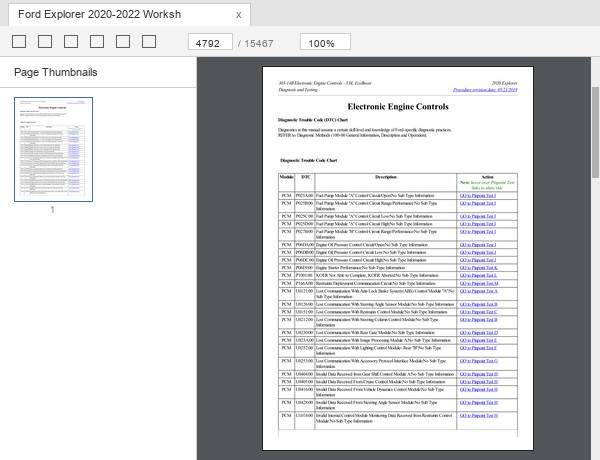
Sample pages from this manual
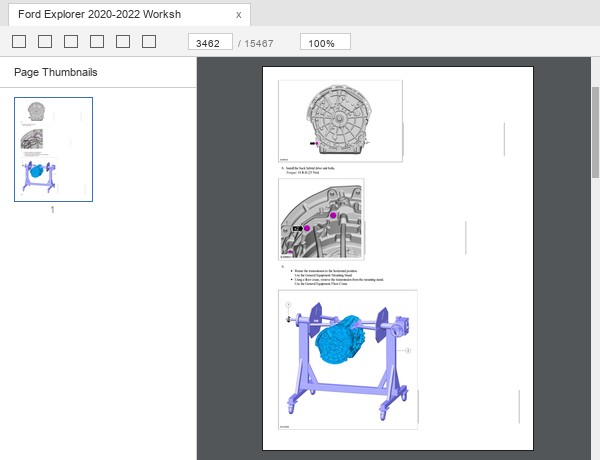
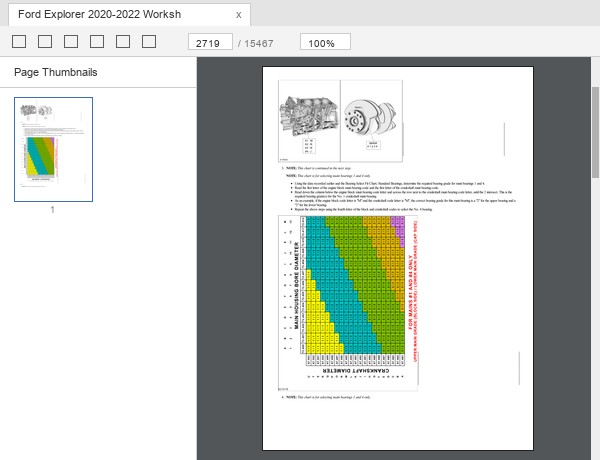
Three pages lifted straight out of the file, unedited, so you can judge the level for yourself:
What you can repair with it
Diagnosis is where this set earns its keep. Pinpoint tests are called on 6,157 times, there are 1,289 distinct trouble codes charted, and connectors are referenced 44,167 times with the pin, circuit, wire gauge and qualifier set out in a table beside the test step. A pinpoint test tells you which terminal to back-probe, what the meter should read, and which branch to take from each answer, so a fault gets cornered instead of guessed at.
The 2020 redesign put the Explorer on a rear drive architecture, and the driveline sections were rewritten to match. You get the power transfer unit, transfer case, four wheel drive control, both halfshaft sets and both differentials, alongside separate front suspension sections for the rear drive and all wheel drive cars because the geometry differs between them.
Four powerplants are documented independently: the 2.3L EcoBoost, the 3.0L EcoBoost twin turbo that sits in the ST, the naturally aspirated 3.3L Duratec V6, and the 3.3L hybrid. Independently means what it says. Cooling, ignition, starting, emission control, evaporative emissions, intake, fuel charging and electronic engine controls all appear four times over, once per engine, so nothing you read has been averaged across a range.
Hybrid work is fully supported. The pack is built from pouch cells delivering roughly 300 volts DC, and the manual walks the high voltage battery, its mounting and cables, the electric motor, the electric powertrain cooling loop, the powertrain control strategy and the voltage converter and inverter that steps the pack down to the 12 volt system. Service disconnect, isolation checks and the diagnostic thresholds the modules use are all written out.
Three gearboxes are treated as three gearboxes. The 10R60 behind the four cylinder, the 10R80 behind the V6 and the 10R80 MHT with its motor in the bellhousing each get overhaul, external controls and cooling sections of their own, down to the clutch pack clearances and the exploded views with part numbers on the callouts.
Body and collision work is unusually complete for a download. Front end, roof, side panel and rear end sheet metal repairs are all here, with the tolerance checks used to measure a damaged shell, the subframe and uni-body mounting section, and the paint general information. If you are a bodyshop rather than a home mechanic, that half alone is worth the price.
Ford's Police Equipment section is in the set as well, which is not something you often see. Flasher lighting, the siren and speaker system, LED lamps in the grille, mirrors and headliner, the flasher switch pad and group flash pattern programming are all documented, and the police fitment carries through into the interior trim and transmission sections.
Manual language and format
Everything is in English.
The download is a single PDF of 15,467 pages, about 714 MB, and there is nothing to extract. That matters more than it sounds. Because it is one file, a search for a connector number, a DTC or a torque figure runs across the whole vehicle at once and lands you on the page, wherever in the 152 numbered sections it happens to live. Bookmarks follow Ford's own section tree.
The file has been prepared carefully on our side. It opens without a password, printing and copying are enabled, the text layer is clean so search actually finds what you type, and the page furniture that comes with files of this kind has been taken out so you are looking at Ford's pages and nothing else.
The one thing to be square about is wiring. There are no circuit schematics in this release. Connector numbers, pin-out tables, module descriptions and the full diagnostic tree are all present and are what most jobs actually need, but if you were expecting drawings of the harness you will not find them here.
No software, no serial number, no activation. It opens in whatever PDF reader you already have, on a laptop in the workshop, a Mac, an iPad or a phone.
Questions about this manual
Will it fit my 2023 or 2024 Explorer?
Those cars are mechanically the same generation and much of this will read across, but the data set here is written to the 2020 to 2022 build and we will not claim more than that. Later running changes are not reflected.
Are wiring diagrams included?
No. Read that twice before you buy, because it is the one gap. What you do get is the diagnostic half in full: 6,157 pinpoint test references, 1,289 trouble codes and 44,167 connector references with pin-out tables. Circuit drawings are not part of this release.
Does it cover the hybrid?
Yes, and properly. The 3.3L hybrid has its own engine, cooling, ignition, starting, emissions, intake and controls sections, and on top of those the electric motor, high voltage battery and cables, electric powertrain cooling, electric powertrain control, the voltage converter and inverter, and the 10R80 MHT transmission.
Does it cover the Police Interceptor Utility?
It does. Section 100-05 Police Equipment covers the flasher lighting, siren and speaker system and the LED lamp fitments, and the police version is called out separately in the interior trim and transmission fluid specifications.
How much fluid does the ten speed take?
It depends which one you have. A dry fill is 12.9 quarts, 12.2 litres, for the 10R60, 13.0 quarts, 12.3 litres, for the 10R80, and 13.7 quarts, 13 litres, for the 10R80 MHT in the hybrid, rising to 14.8 quarts for the police hybrid. All three call for Motorcraft MERCON ULV to WSS-M2C949-A. A drain and refill takes less than a dry fill.
Is it one file or a folder full of them?
One PDF. Some manuals of this size arrive as an archive split into dozens of section files, which means you have to know where to look before you can search. This one is a single searchable document, so you type the part number and go.
How does it compare with a paperback repair book from a parts shop?
They are not the same kind of thing. A shelf book gives you a couple of hundred pages covering several model years at once, written by an author working from the outside. This is 15,467 pages of the information Ford issues to its own dealer network for one vehicle. Each of the four engines gets its own complete set of chapters instead of one shared summary. Torque figures sit inline with the step, against the exact fastener, in Newton metres and pound feet. Diagnosis runs on Ford's pinpoint trees with the connector, the pin and the expected reading named at every branch. And you get the material a general book will not attempt at all: the high voltage hybrid system, the ten speed automatics stripped to their internals, the Police Equipment fitment, and full collision and sheet metal repair with the tolerance checks. The trade off is the missing schematics, which is why we say so in three places on this page.
How you receive it
Payment is taken securely and the download link is issued as soon as it clears, usually within a minute. Nothing ships and there is no disc to wait for. The link does not expire, so if the laptop in the workshop dies you can pull the file down again.
Ford F-150 2015-2020 Workshop Repair Manual
|
Ford F-150
Compatible with: All Windows Systems |
Ford F-150
Just £9.95
Instant Download |
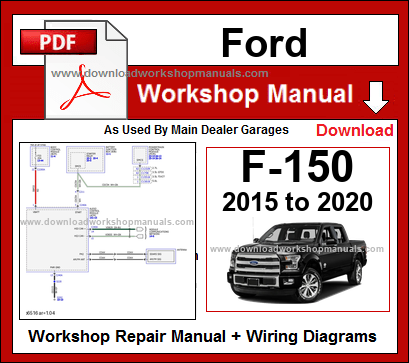
This download covers the whole thirteenth generation F-150, the aluminium-bodied truck Ford built from 2015 to 2020. It is two complete factory manuals, 33,918 pages between them, and you get both for one price.
Ford facelifted this truck for 2018 and changed a great deal underneath while it was at it, so one book cannot honestly cover all six years. The first manual runs to 13,343 pages and documents the 2015 to 2017 trucks. The second runs to 20,575 pages and documents 2018 to 2020, including the engines and the gearbox that arrived with the facelift. Whichever year you own, the coverage here is the coverage Ford wrote for it.
Read this before buying so you know exactly what you are getting. This is two PDFs in one download, not a single file: open the 2015-2017 book for a pre-facelift truck and the 2018-2020 book for a facelift truck. Both carry full wiring diagrams. One cosmetic point worth knowing in advance: in the specification tables the registered trademark and degree symbols did not survive the original conversion cleanly, so Motorcraft and MERCON read with a stray letter in front of the symbol. No figure, torque value or procedure is affected.
Which vehicles this manual fits
- Fits: Ford F-150, thirteenth generation, in Regular Cab, SuperCab and SuperCrew form, two wheel drive and four wheel drive, including the Raptor in the 2018-2020 book
- Covers years: 2020, 2019, 2018, 2017, 2016, 2015
- Engines, 2015 to 2017: 2.7L EcoBoost (238 kW / 324 PS), 3.5L EcoBoost (272 kW / 370 PS), 3.5L Duratec naturally aspirated V6 (209 kW / 284 PS) and the 5.0L V8
- Engines, 2018 to 2020: 3.3L Duratec V6 and the 3.0L Power Stroke turbo diesel, both new for the facelift, alongside the 2.7L EcoBoost, the 3.5L EcoBoost and the 5.0L Ti-VCT V8
- Gearboxes: the 6R80 six-speed automatic with SelectShift on the earlier trucks, and the 10R80 ten-speed automatic on the later ones, each with its own overhaul, external controls and cooling coverage
- Driveline: 8.8 inch and 9.75 inch rear axles, the electronic locking differential, front drive axle and halfshafts, transfer case including the Raptor 4HI-LOC torque on demand case, and the four wheel drive systems
- Body: the aluminium body that defines this generation, with panel repair, riveting and bonding covered throughout
- Wiring: full schematics in both books, with circuit numbers, wire colour codes, connector views, pin-outs, splices and ground points
- Language: English
- Pages: 33,918 across two PDFs, 13,343 for 2015-2017 and 20,575 for 2018-2020
- File type: ZIP archive of two PDFs, 805 MB
Inside this manual
Every entry below is a subsystem the two documents cover under their own headings, across all six years:
- Engine, overview and in-vehicle repair, every engine
- Cylinder Head LH and RH
- Engine Front Cover and Timing Chain
- Crankshaft Front Seal, Oil Pan and Oil Cooler
- Engine Mount LH and RH
- Accessory Drive
- Engine Cooling
- Engine Ignition
- Electronic Engine Controls
- Starting System
- Charging System, by engine
- Fuel System and Fuel Charging
- Fuel Tank and Lines
- Turbocharger, EcoBoost engines
- 3.0L Power Stroke diesel, engine and fuel system
- Glow Plug System, diesel
- Diesel emission control and exhaust aftertreatment
- Intake Air Distribution and Filtering
- Evaporative Emissions and Engine Emission Control
- Exhaust System
- Automatic Transmission, 6R80 six-speed
- Automatic Transmission, 10R80 ten-speed
- Automatic Transmission External Controls
- Transmission Cooling
- Raptor transmission and driveline
- Four-Wheel Drive Systems
- Transfer Case, including 4HI-LOC torque on demand
- Driveshaft
- Rear Drive Axle and Differential, 8.8 and 9.75 inch
- Electronic Locking Differential (ELD)
- Front Drive Axle, Differential and Halfshafts
- Wheel Hubs and Bearings
- Suspension System, front and rear
- Wheels and Tires
- Tire Pressure Monitoring System (TPMS)
- Wheel alignment specifications
- Brake System, general information
- Front and Rear Disc Brake, Hydraulic and Power Actuation
- Parking Brake and Actuation
- Anti-Lock Brake System (ABS) and Stability Control
- Auxiliary Brake System, trailer brake control
- Power Steering
- Steering Column and Column Electrical Components
- Steering Linkage
- Climate Control System, manual and automatic
- Instrumentation, Message Center, Panel and Switches
- Information and Entertainment System
- SYNC module and touchscreen systems
- Bang and Olufsen audio system
- Front Controls Interface Module (FCIM)
- Module Communications Network and data lines
- Body Control Module (BCM)
- Module hardware test routines, APIM, BCM, IPC, PCM
- Diagnostic Trouble Code (DTC) charts and descriptions
- Pinpoint Tests
- Engine Controls reference values and symptom charts
- System Wiring Diagrams, by circuit
- Engine performance and transmission circuits, per engine
- Power Distribution and Ground Distribution circuits
- Connector Views, Pin-outs, Splices and Ground Points
- Battery, Mounting and Cables
- Generator and Regulator
- Direct Current to Direct Current (DC/DC) Converter
- Exterior Lighting and Headlamps
- Fog, Turn Signal and Hazard Lamps
- Parking, Rear, License Plate and Trailer Lamps
- Interior Lighting and Instrument Illumination
- Passive Anti-Theft System (PATS) and Forced Entry
- Cruise Control and Adaptive Cruise Control
- Parking Aid and 360 degree camera
- Pro Trailer Backup Assist
- Blind Spot Information and Lane Keeping
- Collision Warning, Avoidance and Pre-Collision Assist
- Rear View Mirrors and Memory Mirrors
- Handles, Locks, Latches and Entry Systems
- Glass, Frames, Mechanisms, Wipers and Washers
- Roof Opening Panel
- Front Seats, Rear Seats and Memory Seats
- Power Running Board (PRB)
- Interior and Exterior Trim, Body Closures and Pickup Box
- Body repairs, aluminium panels, rivets and adhesive
- Supplemental Restraint System and Seatbelts
- Noise, Vibration and Harshness (NVH)
- Jacking, Lifting and Specifications
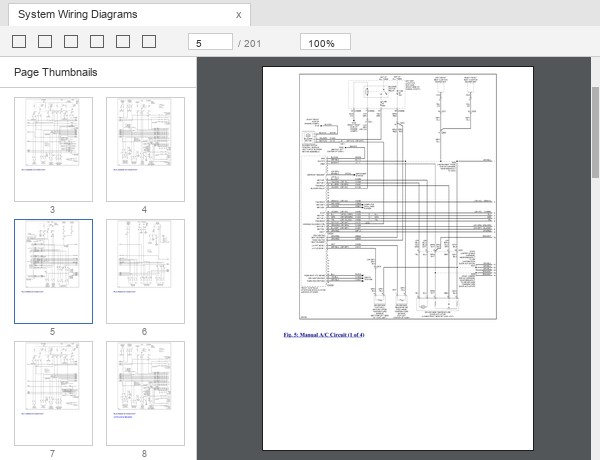
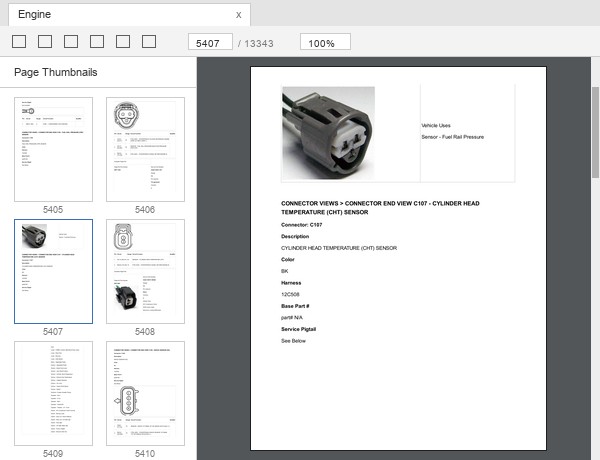
Sample pages from this manual
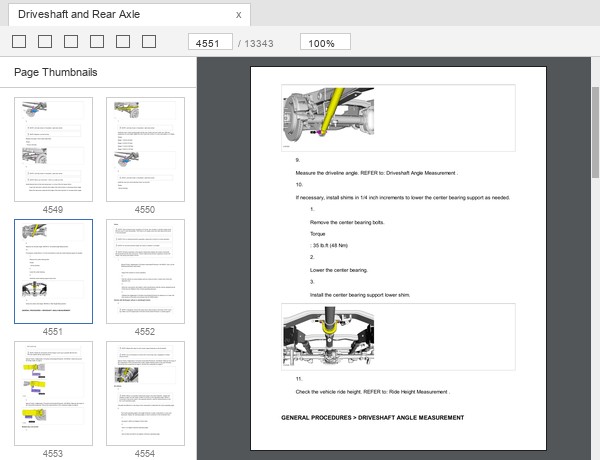
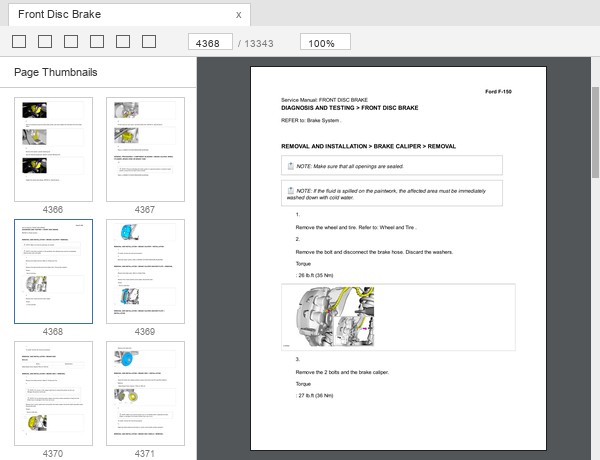
These are real pages taken from both documents, so you can see exactly what you are buying:
What you can repair with it
The two books together give you the whole generation, and the split matters more on this truck than on most. Ford changed the engine range and the gearbox for 2018, so a 2016 owner and a 2019 owner are working on genuinely different vehicles even though the truck looks similar. Buying one book and finding it stops in 2017 is the usual disappointment with this generation. That does not happen here.
The diagnostic half is the part worth paying for. Between them the documents carry many thousands of references to Ford's pinpoint tests, along with powertrain DTC charts, symptom charts and reference values. A pinpoint test tells you which terminal to back-probe, what reading to expect and what to do with each answer, so you follow a decision tree to the fault instead of working through a list of likely causes. The 2018-2020 book adds module hardware test routines for the APIM, BCM, instrument cluster and PCM, which tell you whether a module is actually faulty before you buy one.
Engine work is complete and separate for every unit Ford fitted across the six years. The naturally aspirated 3.5L Duratec and the early 2.7L and 3.5L EcoBoost engines are in the first book. The 3.3L Duratec and the 3.0L Power Stroke diesel, both introduced with the facelift, are in the second, the diesel with its own fuel system, glow plugs and exhaust aftertreatment. Cylinder heads, front covers, timing chains, crankshaft seals, oil pans and mounts each have their own removal and installation procedure with the torque figure quoted inline at the step.
Both gearboxes are covered to overhaul level: the 6R80 six-speed on the earlier trucks and the 10R80 ten-speed on the later ones, each with external controls, cooling and the exploded views with Ford part numbers. The Raptor is documented in the 2018-2020 book, including its own transmission, driveline and the 4HI-LOC torque on demand transfer case.
Wiring is covered properly in both halves, which is the half most downloads leave out. The 2018-2020 book carries a System Wiring Diagrams section of 196 numbered circuit figures across 40 named circuits, most of them spread over several sheets. Every engine gets its own engine performance and automatic transmission circuit, and there are separate anti-lock brake circuits for the Raptor and for everything else. Power distribution, ground distribution, computer data lines, body control modules, the instrument cluster, headlights, exterior lamps, cruise, navigation with the Bang and Olufsen system, memory seats and memory mirrors all have their own drawings, with wire colours, connector numbers, splices and ground points marked. Alongside them sit connector views and pin-out tables giving pin, circuit, gauge and qualifier for each terminal.
Body repair matters more on this generation than on any Ford truck before it. The panels are aluminium, riveted and bonded where a steel truck would be welded, and the repair procedures reflect that. If you are quoting or carrying out collision work on one of these, that section alone justifies the download.
Driver assistance is documented module by module across both books: adaptive cruise, lane keeping, blind spot information, pre-collision assist, parking aid with the 360 degree camera, and Pro Trailer Backup Assist, each with its own diagnosis and module coverage.
Manual language and format
English is the only language in the set. The download is a ZIP archive holding two PDFs, one for each half of the generation, and you extract it before use. Both are fully searchable, so typing a part number, a DTC or a section name takes you straight to it within whichever book you have open. Sections are named plainly and both documents are bookmarked the way the source was issued.
The content is Ford's own service information, licensed and reissued in this form. The illustrations carry Ford's figure numbers and the note "Courtesy of FORD MOTOR COMPANY", and the procedures are Ford's, with Ford part numbers, Ford special tool references and Ford torque figures throughout.
One limitation to be aware of, and we would rather say it here than have you find it. In the specification tables the registered trademark and degree symbols did not survive the original conversion cleanly, so Motorcraft and MERCON read with a stray capital letter in front of the symbol. It is cosmetic and confined to those symbols. No figure, torque value, wire colour or procedure is affected.
Nothing installs and nothing needs activating. Any PDF reader opens both books, on a workshop laptop, a Mac, a tablet propped on the wing, or a phone.
Questions about this manual
Which of the two books do I need?
The 2015-2017 book for a pre-facelift truck, the 2018-2020 book for a facelift truck. You get both either way, so if you are not sure of your truck's year you are still covered.
Does it cover the 3.0L Power Stroke diesel?
Yes, in the 2018-2020 book, with its own engine, fuel system, glow plug, emission control and exhaust aftertreatment sections. The diesel was only offered on this truck from 2018.
Are wiring diagrams included?
Yes, in both books. The 2018-2020 half alone carries 196 circuit figures across 40 named circuits, with wire colours, connector numbers, splices and ground points, plus connector views and pin-out tables. This is the part most downloads for this truck leave out.
Is the Raptor covered?
Yes, in the 2018-2020 book. It has its own transmission and driveline procedures, the 4HI-LOC torque on demand transfer case, a separate anti-lock brake circuit and its own supplemental restraint coverage.
Which gearbox does my truck have?
Trucks up to 2017 use the 6R80 six-speed automatic with SelectShift. The 10R80 ten-speed came in with the facelift for 2018. Both are covered to full overhaul level, so either way you have the exploded views, the part numbers and the specifications.
Does it cover the aluminium body repair?
Yes. Panel repair, closures, the pickup box, riveting and bonding are all present, which matters on this generation because the repair method changed with the material.
How does this compare with a Haynes or Chilton book?
There is no real comparison. Those books give you a few hundred pages stretched across a whole model range, and typically stop short of the facelift. This is 33,918 pages written for this truck by the people who built it, covering all six years and every engine Ford fitted. Every torque figure is Ford's own and sits inline with the step, against the exact fastener, so you are never hunting a specification table at the back. Diagnosis runs on Ford's pinpoint tests, which name the terminal to probe and the reading to expect at every branch. The illustrations are Ford's, colour coded so the part you are touching is picked out on the page. You also get the things an aftermarket book will not carry at all: full wiring schematics circuit by circuit, both gearboxes stripped to the last circlip, the Raptor, the diesel, and the aluminium body work with its rivet and adhesive specifications. For the price of a single paper manual you get what the dealer technician works from, twice over.
How you receive it
Checkout is secure and the download link arrives once payment clears. Nothing is posted and there is no disc. The link stays live, so you can pull the archive down again whenever you need it.